







If you’ve ever tried to source custom medals in bulk, you already know the real question isn’t “which metal looks nicest.” It’s “which metal keeps my margins healthy, my customers happy, and my reorders coming.” Zinc alloy vs brass medals is the comparison you’ll run into first — and iron usually shows up right after, tempting everyone with its rock-bottom price tag.
Here’s the thing: most guides on this topic read like a metallurgy textbook. Density this, melting point that. Useful if you’re the factory. Less useful if you’re the one deciding what to put in a container heading to your warehouse. So let’s skip the jargon and talk about what actually moves the needle when you’re placing a purchase order — cost per unit, minimum order flexibility, how the product performs after 500 units land at your customer’s door, and whether it’ll still look good six months from now.
Why Material Choice Is Really a Margin Decision
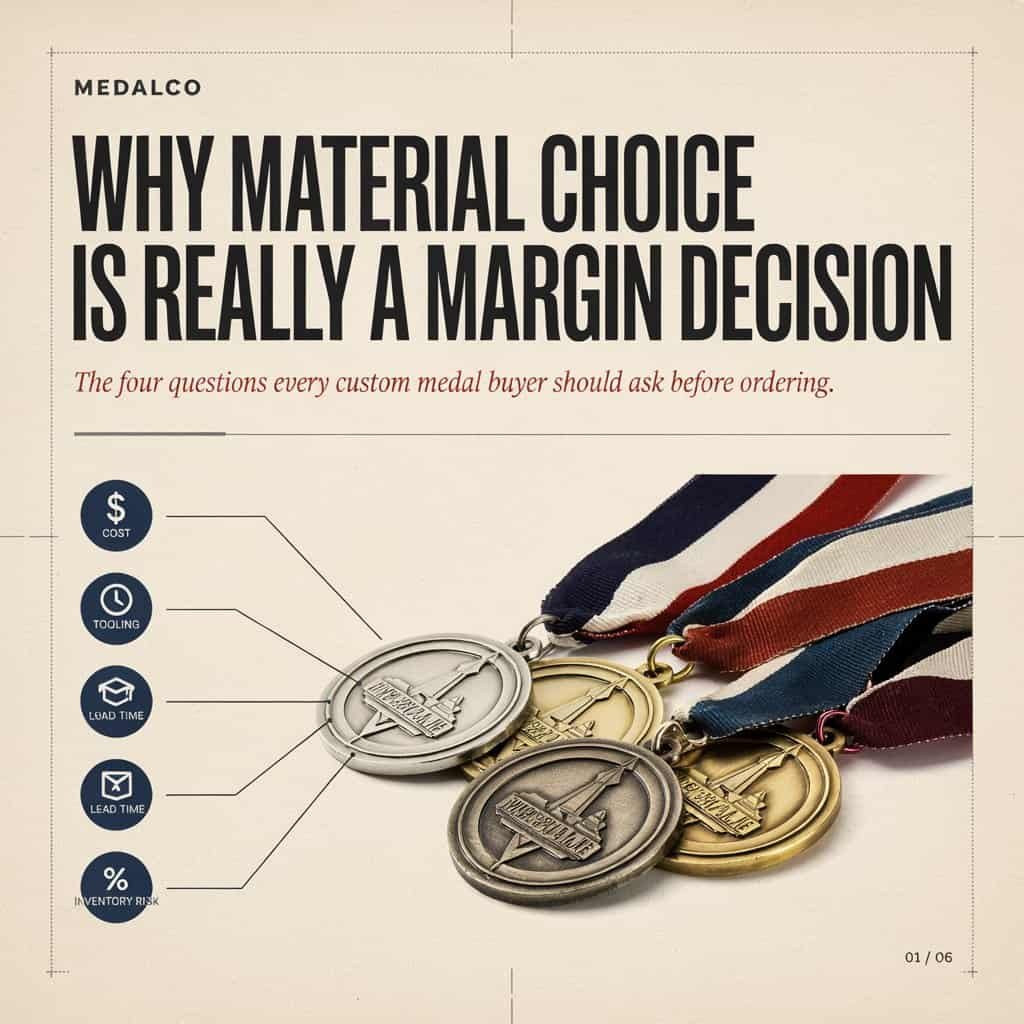
Every material decision you make on a custom medal order ripples through three things: your landed cost, your resale ceiling, and your risk of returns. A cheaper medal that arrives looking premium is a win. A cheap medal that looks cheap — or worse, rusts in someone’s gym bag three months later — is a customer service headache waiting to happen.
So before diving into specs, it helps to frame the decision around four practical questions: What’s my per-unit cost at the volume I’m ordering? How much will tooling or mold fees eat into a smaller first run? How fast can I get product in hand? And will this batch still be sellable if it sits in inventory for a season? Keep those four in your back pocket — we’ll return to them.
Zinc Alloy: The Workhorse for Fast-Moving Inventory

Zinc alloy is die-cast, which is a fancy way of saying molten metal gets injected into a steel mold under pressure. Practically, that means it can capture fine 3D detail, layered relief, and even openwork (cut-out) designs that other processes simply can’t replicate. If your product line needs mascots, skylines, or intricate logos, zinc alloy handles it without blinking.
For anyone running a trading business, a private-label catalog, or an e-commerce storefront testing new SKUs, zinc alloy tends to be the default starting point — and for good reason. It’s forgiving on smaller order sizes, plays nicely with almost any plating finish (gold, antique bronze, black nickel, you name it), and keeps unit costs low enough that you can test a design without betting the farm on it. It also holds up well indoors and resists corrosion when properly plated, so it’s a safe bet for anything that won’t be worn daily in humid or coastal conditions.
Where it comes up short: it’s not the heaviest metal in hand, and for buyers chasing a premium “heirloom” feel, zinc alloy alone won’t get you there — you’ll need to lean on finish and packaging to close that gap.
Best for: seasonal drops, event medals, catalog expansion, and anyone who wants design flexibility without a big upfront commitment.
This is also the tier most annual charity runs land in — our charity medal design guide walks through cause-specific shapes, colors, and pricing.
Brass: When Weight Sells the Story
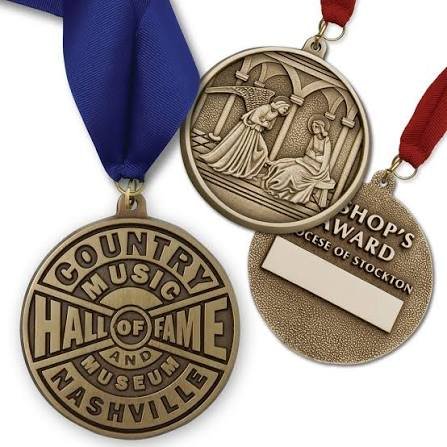
Brass has been the go-to for military honors, service awards, and challenge coins for over a century, and there’s a simple reason: it’s heavy, it’s naturally warm-toned, and it resists tarnish without needing much help. Pick up a brass medal and a zinc alloy one side by side, and most people can feel the difference even if they can’t explain it.
That heft is exactly why brass earns its premium in the market. It’s typically stamped rather than cast, which produces crisp, clean edges and razor-sharp text — ideal for formal designs where detail needs to read clearly from a distance. If you’re supplying corporate anniversary programs, executive recognition gifts, or long-service awards, brass lets you charge accordingly because recipients genuinely perceive it as worth more.
The trade-off is straightforward: brass runs roughly 40-50% more expensive than zinc alloy at comparable volumes, production tends to take a bit longer due to the material’s hardness, and you lose the ability to do openwork or ultra-deep 3D relief. For a high-SKU-turnover business chasing volume, that premium may not pencil out. For a brand building a loyalty or milestone program, it often pays for itself in perceived value alone.
Best for: premium retail tiers, loyalty programs, milestone awards, and anywhere the “feel” of the product is part of the pitch.
Iron: The Budget Option (With a Catch)

Iron is the cheapest of the three, sometimes by a wide margin, which makes it tempting for enormous one-off runs — think 5,000-piece giveaways at a trade show or a single-season promotional campaign. It stamps quickly, it’s widely available, and it takes plating just fine for a gold or silver look on a shoestring budget.
Here’s the catch every buyer needs to know before ordering: unprotected iron rusts. Not eventually — sometimes within months if the plating gets scratched. That’s a manageable risk for a giveaway that’s handed out and forgotten. It’s a much bigger risk if you’re stocking iron medals as retail inventory that might sit in a warehouse for six months, or shipping to customers with a generous return policy. A single batch of returned, rust-spotted medals can wipe out whatever you saved on the unit price.
If iron is genuinely the right call for your order — high volume, short shelf life, tight budget — just make sure your custom metal medals come with proper plating thickness and a sealed clear coat. That single spec conversation with your manufacturer can be the difference between a smooth reorder and a support ticket nightmare.
Best for: one-time events, promotional giveaways, and budget SKUs that move fast — not for anything sitting in long-term inventory.
Quick Comparison at a Glance
| Factor | Zinc Alloy | 황동 | 철 |
|---|---|---|---|
| Unit cost | $$ | $$$ | $ |
| Design flexibility (3D/openwork) | Best | Good | Limited |
| 리드 타임 | Fast | Slower | Fastest |
| Perceived value | Medium-High | Highest | Low |
| Return/rust risk | Low | Lowest | Higher |
| Best use case | Volume + variety | Premium markup | Bulk promo |
Matching Material to Your Playbook
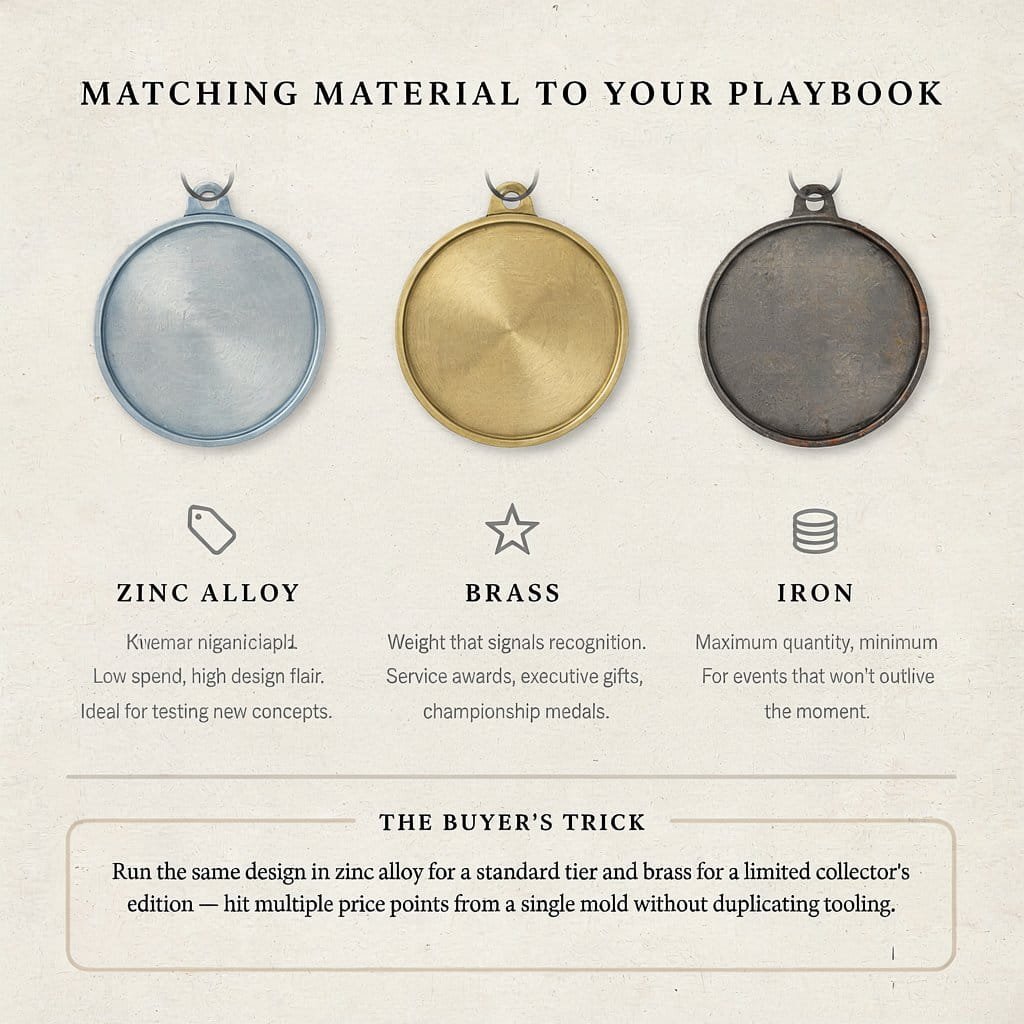
None of these materials is universally “better” — they’re better for something. If you’re testing a new product concept and want to keep initial spend low while still offering design flair, zinc alloy checks every box. If you’re building a program where recipients are meant to feel recognized — a 25-year service award, an executive gift, a championship medal — brass carries that message in its weight alone. And if the goal is simply maximum quantity for minimum spend on something that won’t outlive the event it’s made for, iron gets the job done as long as you respect its limits.
One trick savvy buyers use: you don’t have to lock into one metal per product line. Running the same design in zinc alloy for a standard tier and brass for a limited “collector’s edition” tier lets you hit multiple price points from a single mold — without duplicating your entire tooling investment.
Finish Matters as Much as the Metal
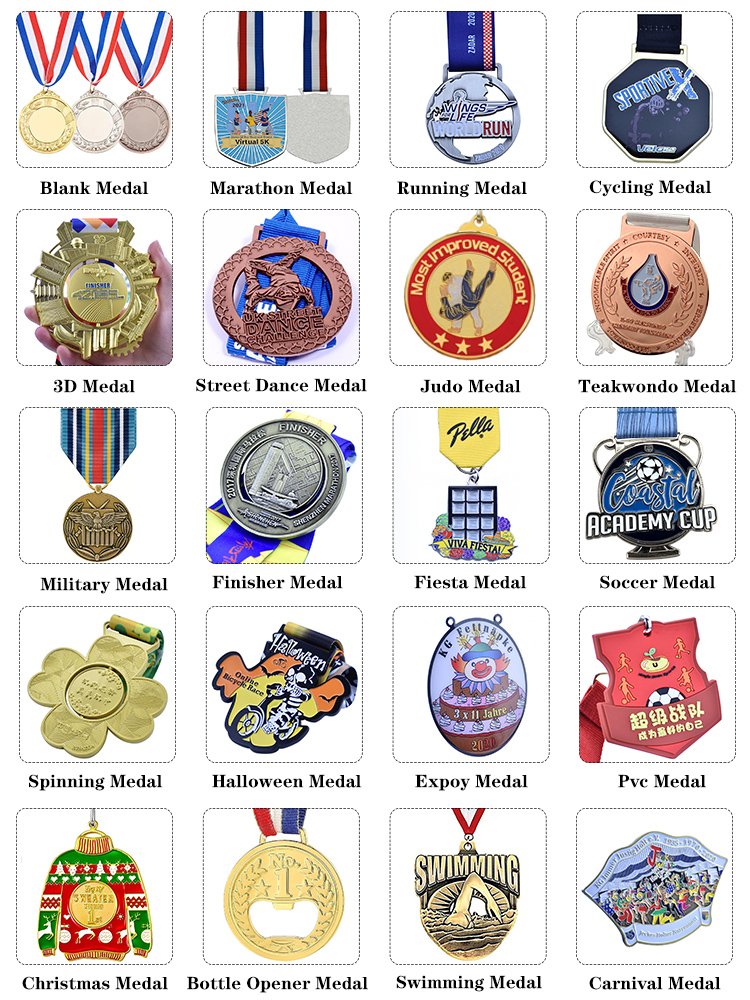
Here’s something that surprises a lot of first-time buyers: plating and finish often influence perceived value more than the base metal underneath. A zinc alloy medal with a polished gold-mirror finish can look every bit as premium in a product photo as a brass one — the difference only shows up when someone picks it up and feels the weight. Soft or hard enamel color fills add durable, vibrant branding, while printing handles gradients and photo-style detail beautifully on both zinc alloy and iron.
Antique finishes (antique gold, antique silver, antique bronze) are worth knowing about too — they hide minor scratches and fingerprints, which is genuinely useful if your medals are going to be handled a lot at events or trade shows.
Before You Place That Order
A few questions worth asking any medal manufacturer before you commit:
- What’s the mold or tooling fee, and how many free design revisions are included?
- What’s the minimum order quantity, and does pricing improve meaningfully at higher tiers?
- For iron or zinc alloy orders, what plating thickness and sealing process do you use?
- Can I get a sample in two different materials before committing to a full production run?
- What’s your realistic lead time from approved proof to shipped goods?
Getting straight answers to these upfront saves you from surprises three weeks into production — and it’s usually a good early signal of how easy (or difficult) a medal manufacturer will be to work with long-term.
결론
Choosing between zinc alloy, brass, and iron isn’t really about which metal wins in the abstract — it’s about matching the material to your margin strategy, your customer’s expectations, and how long that product needs to look good after it leaves the box. Zinc alloy covers most bulk medal orders with the best balance of cost and flexibility, brass earns its keep wherever prestige is the whole point, and iron is a smart tool for short-lived, high-volume runs as long as you go in eyes open about the rust risk.
Whichever direction fits your next order, the fastest way to know for sure is to get a real sample in hand — request a quote to us, ask for a side-by-side proof in two materials, and let the metal make its own case.
자주 묻는 질문
Is zinc alloy or brass better for custom medals?
It depends on your goal. Zinc alloy offers better design flexibility (3D relief, openwork designs) and a lower unit cost, making it the smarter pick for most bulk orders. Brass costs roughly 40-50% more but delivers a heavier, more premium feel — worth it for milestone awards, executive gifts, or programs where perceived value justifies the price.
What’s the cheapest medal material for bulk orders?
Iron is typically the lowest-cost option, especially at high volumes (5,000+ pieces). It works well for one-time giveaways and short-term promotions, but it’s not recommended for stocked retail inventory since it’s prone to rust if the plating gets scratched or worn.
Do iron medals actually rust, and how can I reduce that risk?
Yes — unprotected iron can start rusting within months once the plating is compromised. To minimize this, make sure your manufacturer applies adequate plating thickness (gold, nickel, or bronze) plus a sealed clear coat. Always ask for these specs upfront if you’re considering iron for your order.
What’s the minimum order quantity for custom brass or zinc alloy medals?
MOQs vary by manufacturer, but many suppliers — including ours — offer no strict minimum, with better per-unit pricing kicking in at higher volumes. It’s worth confirming tiered pricing and mold/tooling fees before committing to your first run.
Can I use different materials for different tiers of the same product line?
Absolutely, and it’s a smart strategy. Many buyers run the same design in zinc alloy for a standard tier and brass for a limited “premium” or “collector’s edition” tier — hitting multiple price points from a single mold without duplicating your entire tooling investment.