








If you’ve typed “is a keychain business profitable” into Google, you’re probably wondering if it’s worth your warehouse space or your next purchase order. We’ve already covered whether people are still buying keychains — spoiler: demand for custom keychains remains strong. So let’s assume demand is settled. This article tackles the harder question: if people want them, does running a keychain business actually make you money?
The short answer: yes, a keychain business can be genuinely profitable — but how profitable depends almost entirely on how you calculate your numbers, not just what you sell. A hobbyist hand-making one keychain at a time and a buyer placing a 1,000-piece bulk order are playing two completely different financial games. Let’s break down the real math, the real risks, and what actually separates a keychain side-hustle from a scalable product line.
How Profitable Is the Keychain Business in 2026?
Here’s the honest, no-fluff version:
| Sourcing Approach | Typical Markup | Growth Ceiling |
|---|---|---|
| Small-batch / handmade | ~1.5x–2x, capped by production time | Low — limited by hours in the day |
| Bulk wholesale sourcing | 3x–10x, scalable with volume | High — limited mostly by demand and cash flow |
The gap between these two rows is the entire story. A solo maker doing five keychains a week isn’t running a scalable keychain business — they’re running a craft hobby with a nice margin on paper but no real capacity to grow. A buyer who sources through a factory, negotiates a bulk unit price, and sells through multiple channels is running an actual business with room to expand. If you’re a trader, a brand, an e-commerce platform, or a retail buyer, you’re almost certainly aiming for the second category — and that’s where the real profitability question gets interesting.
The Profit Formula Nobody Talks About

Most “is X profitable” articles stop at markup percentages. That’s only half the equation. The number that actually matters is your break-even volume: how many units you need to sell before your fixed costs (tooling, samples, packaging design, shipping setup) stop eating your margin.
Here’s a simplified way to think about it:
Break-even units = (Tooling + Sample + Design costs) ÷ (Resale price − Unit cost − Per-unit fees)
Say your setup costs run $150 for a new keychain shapes mold and sample approval, your unit cost is $1.20, your resale price is $12, and marketplace fees eat about $1.50 per sale. Your profit per unit is $9.30, meaning you’d break even after roughly 16 units — and every sale after that is closer to pure margin. This is why bulk buyers who plan their SKU lineup around a handful of core shapes, rather than dozens of one-off designs, tend to hit profitability faster. Fewer molds, faster break-even, more repeat runs of the winners.
Channel Comparison: Where the Real Margin Differences Show Up
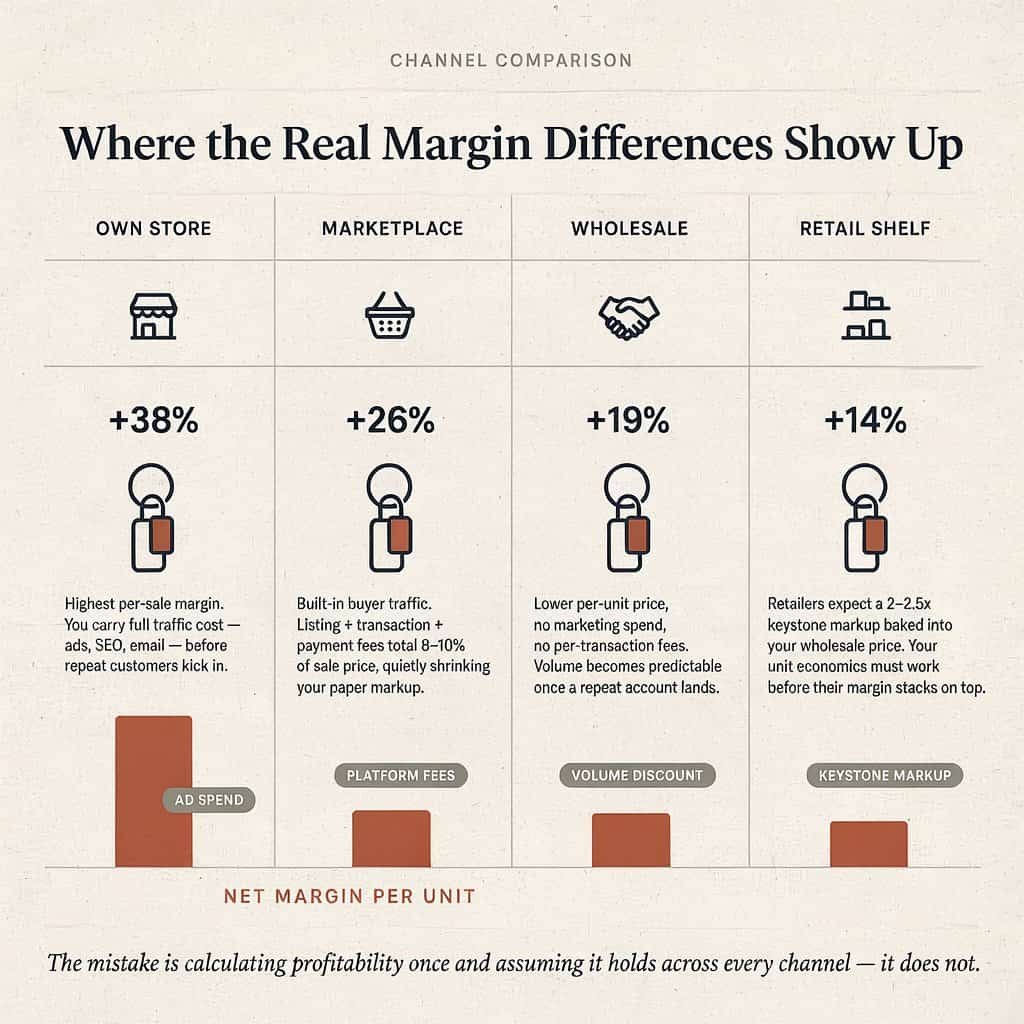
The same keychain, sold through different channels, produces wildly different net profit — and this is a variable most sourcing guides skip entirely.
Your own online store. You keep the most margin per sale (no marketplace commission), but you carry the full cost of traffic acquisition — ads, SEO, email — which can be expensive before you have repeat customers.
Marketplaces (Etsy-style platforms). Built-in buyer traffic is the upside; listing fees, transaction fees, and payment processing typically total 8–10% of the sale price, which quietly shrinks the markup you calculated on paper.
Wholesale to retail buyers. Lower per-unit price, but no marketing spend and no per-transaction fees — and volume tends to be far more predictable once you land a repeat account.
Retail shelf placement. Retail buyers usually expect a 2–2.5x keystone markup baked into your wholesale price, so your unit economics need to work before the retailer adds their own margin on top.
None of these is objectively “best.” The mistake is calculating profitability once and assuming it holds across every channel — it doesn’t.
The Scaling Trap Most New Sellers Fall Into

Here’s a pattern that shows up constantly: a seller starts strong with a niche product — say, matching bff keychains or trend-driven pieces like a tassel keyring — and the first batch sells out fast. The temptation is to scale by adding more and more design variations. But every new variation usually means a new mold, a new sample round, and a new inventory line to manage, which resets your break-even clock each time.
The sellers who scale profitably tend to do the opposite: they pick a small number of proven keychain shapes and materials, then scale those up in volume rather than out in variety. A level keyring — meaning a consistent, mid-tier finish quality that doesn’t fluctuate order to order — is far easier to reorder at scale than a constantly shifting catalog of one-off designs. Consistency, not novelty, is usually what drives the second and third purchase order.
What Actually Moves the Needle on Margin
A few specific levers do most of the real work here, beyond material cost (which we’ve broken down in detail in our keychain cost guide):
Order volume and MOQ negotiation. Unit cost drops fast once you cross common MOQ thresholds (often 100, 500, or 1,000 pieces).
Reorder rate, not just first-sale price. A design that sells steadily at a modest markup often outperforms a flashy design that sells once. Trend items like a tassel keyring can spike fast, but plan your inventory assuming the trend cools — don’t overcommit tooling budget to a single moment.
Bundling and gifting angles. Paired items like bff keychains often sell in twos, which quietly doubles your average order value without doubling your marketing cost.
Sourcing channel. Buying through a trading company adds a markup layer; buying direct from a factory cuts that layer out but usually requires a higher MOQ and more upfront vetting.
Common Mistakes That Quietly Kill Keychain Margins
A few missteps show up again and again, and they’re almost always avoidable:
- Treating every design as a new SKU without checking whether the reorder rate justifies the extra mold cost.
- Ignoring channel fees when calculating markup — 8–10% marketplace fees add up fast across hundreds of small transactions.
- Chasing every trend (yes, even a great tassel keyring moment) without a plan for what happens when interest cools.
- Underestimating retailer margin expectations and pricing wholesale too close to your own break-even.
- Skipping the sample stage, which is the cheapest insurance policy against a bulk order full of mismatched colors or weak hardware.
A Simple Profitability Checklist
- Calculate your break-even volume before committing to a new design or mold.
- Choose your sales channel(s) first — your margin math changes depending on where you sell.
- Pick a small set of core keychain shapes to scale, rather than constantly expanding your catalog.
- Build in retailer/marketplace margin expectations before you finalize your price.
- Track reorder rate per design, not just first-sale volume.
- Reserve trend-driven pieces (tassel keyrings, seasonal drops) for smaller, faster-turning batches.
결론
A keychain business is absolutely profitable — but the product itself was never the risk. The real variables are your break-even math, your channel choice, and whether you’re scaling proven designs or chasing an ever-growing catalog. Get those three things right, and keychains become one of the easiest, lowest-risk product lines a trader, brand, or retail buyer can add.
If you’re ready to run the numbers on a specific design — whether it’s a classic keychain shapes lineup, a trending tassel keyring, or a matching bff keychains set — a good next step is requesting samples and a bulk quote before committing to a full production run. It’s the cheapest way to make sure the math actually works for your business.
자주 묻는 질문
Is a keychain business profitable in 2026?
Yes, particularly for buyers who calculate break-even volume and source in bulk. Margins of 3x to 10x are common when unit costs are kept low through volume ordering — though channel fees and tooling costs need to be factored in before that markup becomes real profit.
How is demand for keychains looking right now?
Strong. We cover this in detail in our market demand analysis — personalization, gifting occasions, and promotional use all continue driving steady sales.
What is the minimum order quantity for custom keychains?
MOQs typically start around 100 pieces, though unit pricing improves significantly at 500 and 1,000+ units.
Do trend items like tassel keyrings or bff keychains actually pay off?
Often yes for a fast, high-margin sales window — but they’re best treated as smaller, quicker-turning batches rather than the backbone of your catalog, since trend cycles move faster than tooling investment can keep up with.
What keychain shapes or styles have the best reorder rate?
Simple, consistent designs at a reliable “level keyring” finish tend to reorder better than elaborate one-off shapes, since buyers know exactly what they’re getting each time.
Is it cheaper to buy keychains wholesale or make them yourself?
For anything beyond a small hobby scale, wholesale sourcing is almost always cheaper per unit and far more scalable — see our keychain cost breakdown for exact material pricing.