








When athletes bite into their shining prize on the Olympic podium, fans always wonder: are gold medals solid gold? The short answer is no—they haven’t been for over a century.
If that feels surprising, don’t worry. The real story behind what are gold olympic medals made of is a fascinating mix of history, economics, and master craftsmanship. Let’s explore the metallic secrets behind these famous awards.
The Big Reveal: What Are Gold Olympic Medals Made Of?

So, what are gold olympic medals made of today? According to the International Olympic Committee (IOC
) guidelines, a gold medal is mostly… silver!
To break down the exact composition of olympic gold medals, the rulebook states that every gold medal must be composed of:
- At least 92.5% Sterling Silver (making up the vast majority of the medal’s weight).
- A coating of approximately 6 grams of pure gold electroplated onto the exterior.
What about the other podium finishes?
- Silver Medals: Made of the exact same 92.5% sterling silver, just without the gold outer jacket.
- Bronze Medals: Made of approximately 95% copper and 5% zinc — giving them a raw metal melt value of under $10!
A Quick History Lesson: When Were They Ever Solid Gold?
To understand why gold medals aren’t solid gold anymore, a quick trip back in time helps.
Believe it or not, the ancient Greek Olympics didn’t give out medals at all. Winners received simple crowns woven from wild olive branches — a symbol of sacred honor, not material wealth.
Fast-forward to the 1896 Athens Games
, the very first modern Olympics. First-place winners didn’t even get gold! They received silver medals, second place received copper, and third place got nothing but a handshake.
The gold, silver, and bronze hierarchy we know today was officially introduced at the 1904 St. Louis Games
. For a brief moment in history — 1904, 1908, and 1912 — Olympic gold medals were indeed 100% solid gold.
So why did the IOC stop?
Simple economics: World War I caused global metal shortages, and as the Olympic Games grew, making hundreds of pure gold medals became financially unsustainable. The IOC pivoted to high-grade gold-plated silver, and that tradition has remained the gold standard ever since!
Recent host cities have taken this tradition even further with creative materials:
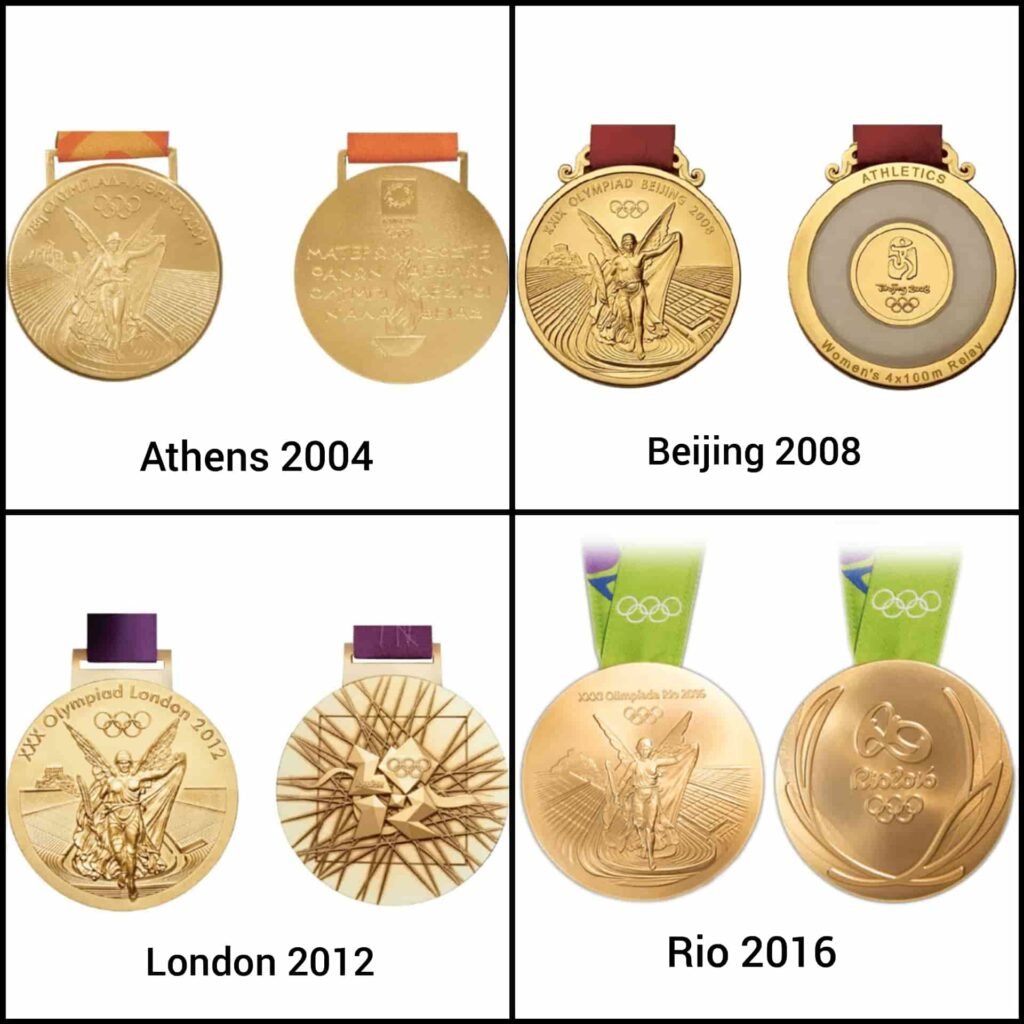
- 2008 Beijing Olympics: Featured elegant, traditional Chinese jade inlays on the back.
- 2020 Tokyo Games: Went 100% sustainable by extracting gold and silver from tons of recycled electronics donated by Japanese citizens.
- 2024 Paris Games: Embedded a genuine piece of original iron salvaged from the Eiffel Tower into the center of every single medal!
The Full Composition of Olympic Gold Medals (2026 Milano Cortina Breakdown)

Let’s get specific about the exact material breakdown — using the upcoming Winter Olympics in Italy as our reference point.
| Component | Specification | Percentage / Weight |
| Core Base | Fine Sterling Silver (925 Grade) | ~98.8% (~500g) |
| Outer Finish | 24K Pure Gold Electroplating | ~1.2% (6g) |
| Total Weight | Heavyweight Custom Stamping | ~500g to 550g |
If a host city attempted to make these heavy 500-gram medals out of solid 24K gold today, a single gold medal would cost around $35,000 to $40,000 just in raw melt value! Multiplying that by hundreds of events would quickly bankrupt most organizing committees.
How Much Gold Is in an Olympic Gold Medal — And What’s It Worth?
This is where things get interesting, especially with precious metal prices hovering at historic highs.
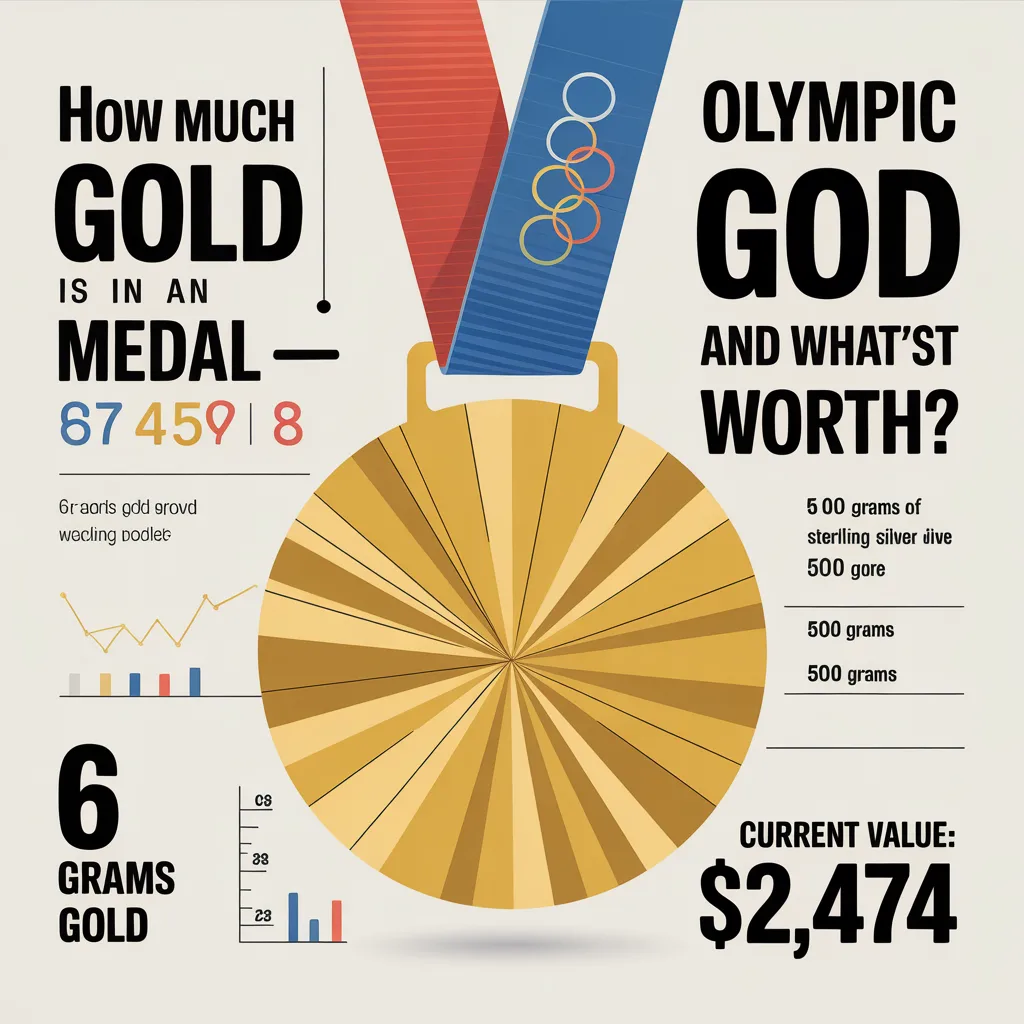
When asking how much gold in olymipic gold medal designs, the answer is exactly 6 grams (about 0.21 troy ounces).
To calculate the raw worth of an olmpic gold medal based purely on scrap metal value:
- 6 Grams of 24K Gold: ~$450 – $500
- 500 Grams of Sterling Silver: ~$400 – $450
That brings the total scrap/melt worth of an olmpic gold medal to approximately $850 – $950 USD.
Melt Value vs. Collectible Value: A World Apart
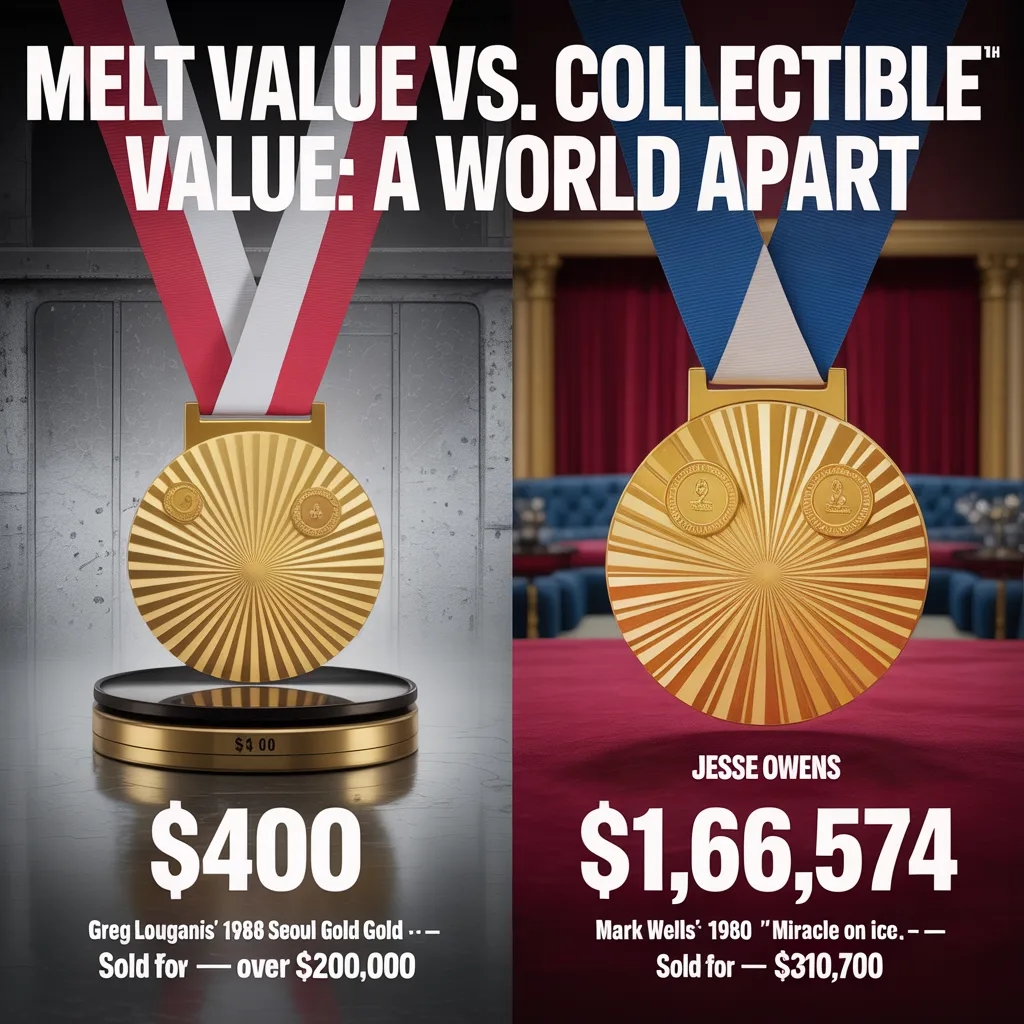
If an Olympian were to sell their freshly won gold medal at a pawn shop, they’d only get the raw melt value. But put that same medal up for public auction, and it rapidly becomes priceless!
Collectors don’t buy bullion by weight; they buy historical moments, human triumph, and iconic prestige:
- Greg Louganis’ 1988 Seoul Gold Medal: Raw melt value around $400, but sold at auction for over $200,000!
- Mark Wells’ 1980 “Miracle on Ice” Medal: Fetched a massive $310,700.
- Jesse Owens’ 1936 Berlin Gold Medal: Set the absolute record, selling for $1,466,574 in 2013!
The gap between raw metal value and collectible value proves that design, craftsmanship, and story matter far more than pure gold weight.
Why Gold Plating Makes More Sense Than Solid Gold
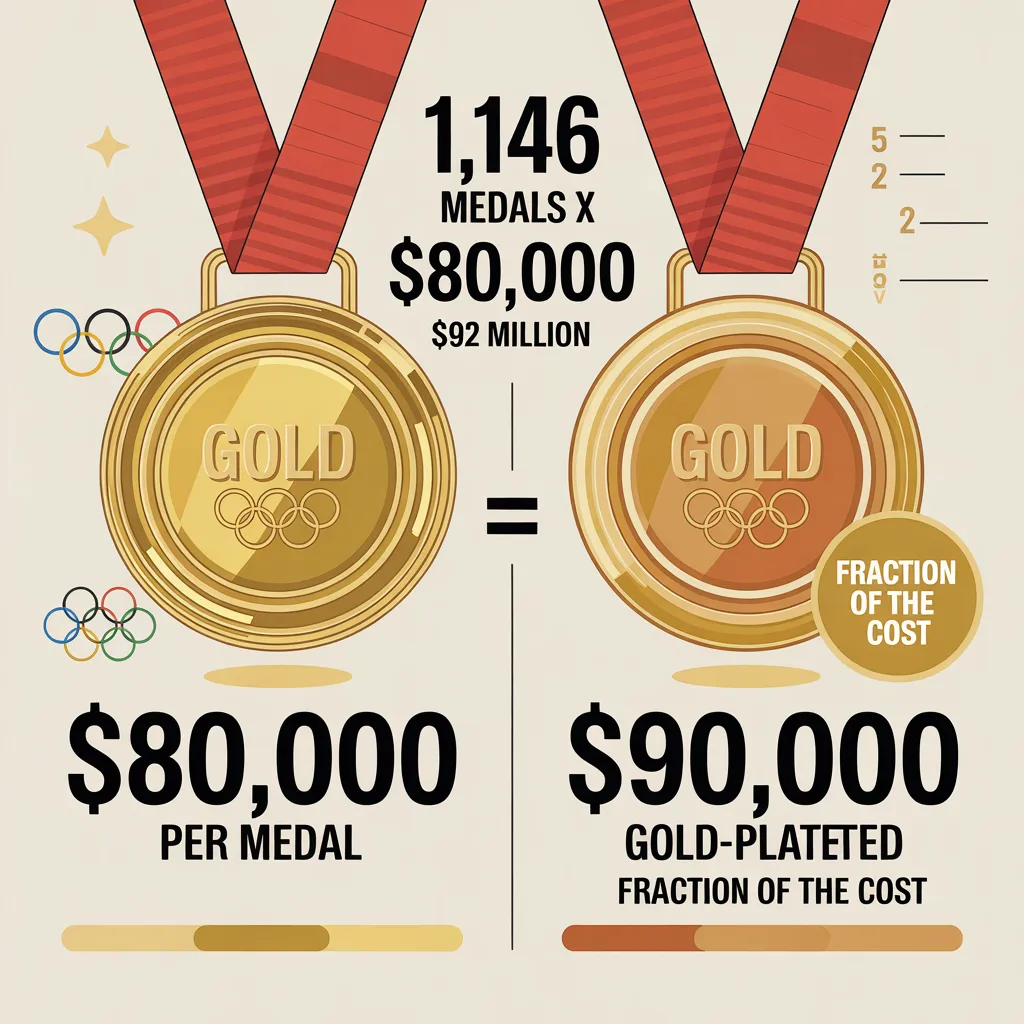
Let’s do the math on why electroplating isn’t “cheating” — it’s smart manufacturing.
If a host committee were to produce 1,146 solid gold medals at $80,000 per medal, the raw metal budget alone would soar past $92 Million!
By switching to high-precision electroplating:
- Organizers achieve the exact same brilliant 24K shine and mirror polish.
- Costs drop by a massive fraction, saving tens of millions while delivering an ultra-durable, tarnish-resistant finish.
- Athletes get a heavy, substantial 500-gram award that lasts for generations without soft 24K gold bending or scratching under touch.
What This Means for Brands Ordering Custom Medals & Award Pins
Here’s the part that’s directly relevant if you’re a trader, brand, e-commerce seller, or retail buyer in the awards space.
The Olympics has been quietly proving a business truth for over a century: you don’t need solid gold to create a premium, high-perceived-value award. What you need is the right finish, the right material specification, and the right design.
In the commercial custom award world, top-tier manufacturers achieve Olympic-level prestige through clever material choices:
- Zinc Alloy & Brass Cores: Provide heavy, satisfying hand-feel and intricate 3D high-relief details.
- Real Gold Electroplating: Applying genuine gold plating over die-struck brass or zinc alloy yields that same mirror luster at a price built for bulk orders.
The Gold Standard Is About Perception, Not Purity
The Olympic gold medal is the most recognized award on Earth — and it’s mostly silver. That’s not a flaw. It’s a masterclass in how symbolism, design, and craftsmanship create value that far exceeds raw materials.
For brands, traders, and retailers, the lesson is clear: the prestige of an award comes from how it looks, how it feels, and what it represents — not the spot price of gold on any given day.
If you’re ready to create your own gold-standard custom medals or award pins — built to impress, priced for scale — get a free quote from Uniquecustompins. Trusted by brands, traders, and retailers worldwide.
Domande frequenti
Are any modern sports medals made of solid gold?
No. Virtually all major global sporting events (including the FIFA World Cup medals, World Championships, and Olympic Games) use gold-plated silver or gold-plated brass/zinc alloy for safety, cost-efficiency, and durability.
Will 6 grams of gold plating rub off over time?
When electroplated correctly using industrial multi-layer electroplating, the gold layer bonds tightly to the base metal. It will not peel or fade under normal handling.
Can small events order medals with real gold plating?
Yes! Custom award manufacturers can apply genuine gold electroplating (in bright gold, antique gold, or rose gold finishes) to custom die-struck medals for marathons, corporate galas, and school competitions.