







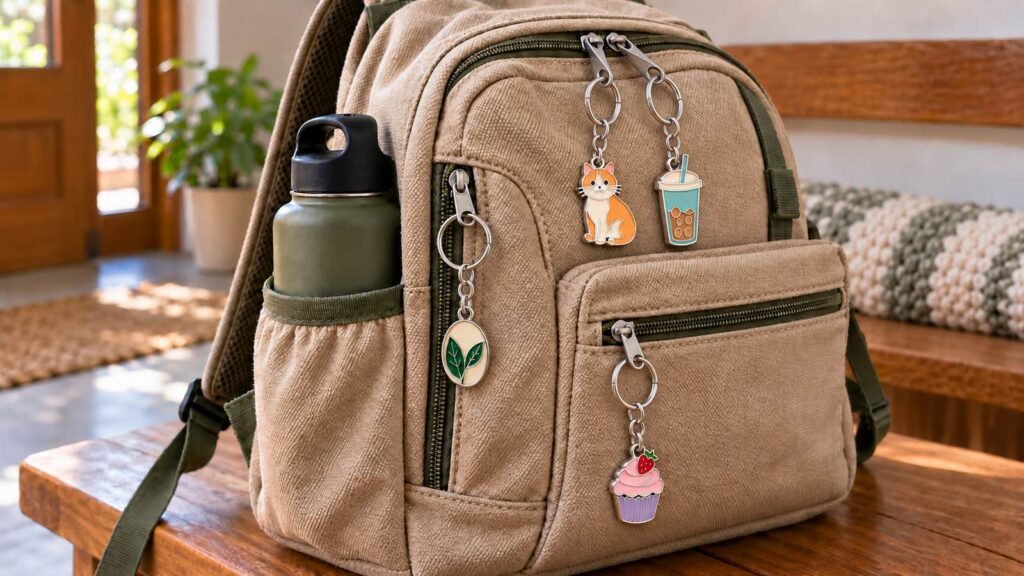
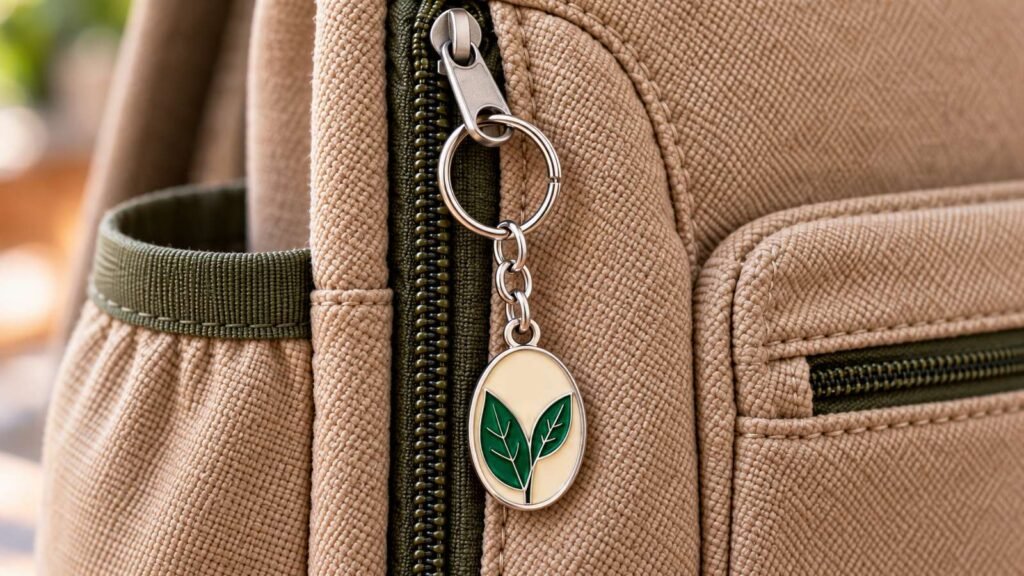
Your brand’s existing enamel keychain may be a starting point for custom bag charms designed for backpacks or small bags. The charm body is the decorated metal piece. In the zipper example here, a connector, such as a ring or chain, links it to the zipper pull tab—the tab used to operate the zipper.
Quick Answer
If its shape, weight and contact surfaces suit the bag, the body may be retained with a connector change. If the hole position, outline or back details interfere with use, assess body modifications. Evaluate existing stock separately from new production: a change possible during manufacturing may be impractical on a finished keychain.
Where Will the Charm Attach: Zipper Pull, Handle Ring or Strap?
Choose hardware around the bag’s attachment point. Overall ring diameter or clasp length alone does not establish whether the connection will fit and move freely.
| Attachment point | Space to check | Selection affected |
|---|---|---|
| Zipper pull tab | Usable hole opening, ring movement and finger clearance | Ring size, connection method and access to the original tab |
| Handle ring | Ring thickness, clasp opening and clearance when closed | Whether the clasp fits, closes and moves freely |
| Strap | Width, thickness and any separate attachment ring | Strap loop or another mounting point |
For zipper placement, check the ring’s wire thickness against the pull-tab opening. Once fitted, the ring should move without binding and leave room to grip the original tab. Open and close the zipper using that tab to check for interference. If the charm is intended to operate the zipper, assess the complete assembly for that function.
On auto-lock sliders, pulling the tab releases the locking mechanism, as YKK explains. Other slider types operate differently. ykkamericas.com
Provide a close-up of the mounting point, its opening dimensions or strap measurements, and the proposed hardware, if known, when comparing keychain attachment options.
Why Can a Bag Charm Hang Sideways or Face Backward?
A design that looks upright on a table may settle differently when suspended. First identify which movement needs correcting.
- Tilting: Check the hanging point against the body’s weight distribution. If the body leans when hanging freely, changing the chain alone may not resolve it.
- Turning sideways: Look at the relative orientation of the zipper pull tab, connecting rings and body hole. Restricted joints can hold the charm edge-on.
- Flipping over: Check how freely the assembly rotates and whether the reverse is suitable for display. Both faces may become visible during use.
Illustrative example: With a ring, short chain and metal charm, an edge-on presentation may call for a connector adjustment. If the body continues to lean when the connection moves freely, its hanging point needs closer review.
A swivel connector allows rotation but does not guarantee that the artwork stays facing outward.
How Do Weight and Drop Length Affect the Bag?
Measure assembled weight with the metal body, rings, chain and any clasp included. Overall drop length runs from the bag’s attachment point to the lowest point of the hanging assembly. Changing the hardware can alter both measurements without changing the charm body.
On a backpack, check where the charm sits relative to a side pocket, its opening and a water bottle. Allow room to remove the bottle. Compare the empty bag with its usual contents inside, since loading can change the bag’s shape and available clearance.
Check whether the assembled weight distorts the fabric around the mounting point or affects normal zipper operation. Include the complete assembly’s weight in grams and drop length in millimeters and inches in the product specification, alongside body dimensions.
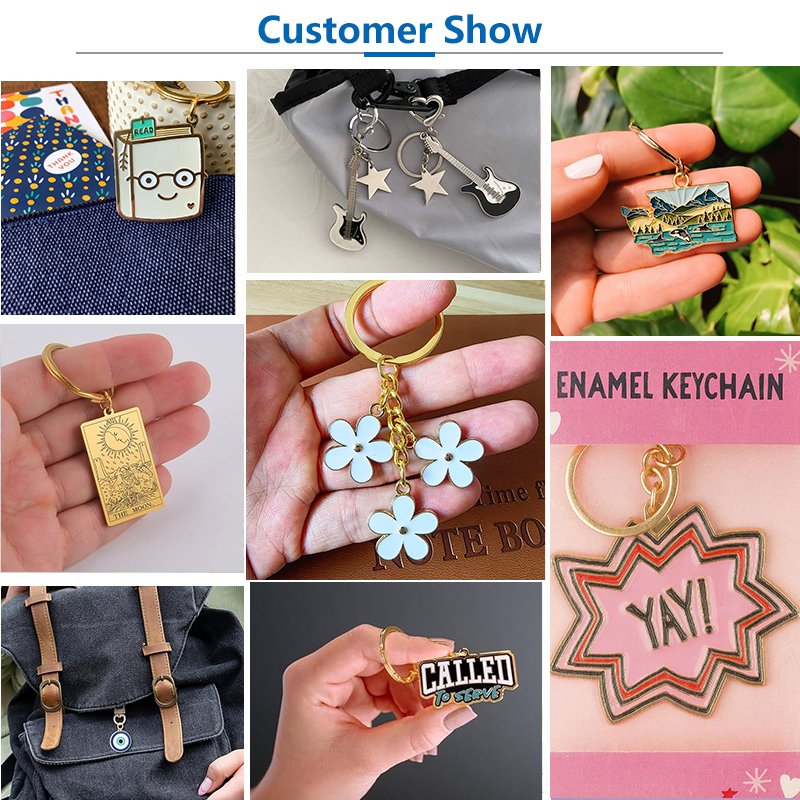
Which Parts Will Touch the Bag?
Check contact points across the assembled charm, including parts hidden from the front.
- Outer outline: Inspect projecting tips and narrow extensions, especially where they sit near fabric folds, seams or pocket edges.
- Back: Look for raised lettering, attachment features or other protrusions that could rest against the bag.
- Connectors: Check where rings, chain links and any clasp touch the bag surface or its existing hardware.
On woven fabric, look for points that could catch threads. On coated fabric or leather, examine where edges or raised details press or rub. A polished appearance alone does not confirm that contact will leave the bag unmarked.
Mark the locations where contact should be reduced on a bag photo. This gives the supplier specific areas to assess when considering changes to the outline, back or connecting hardware.
How Much Branding Belongs on a Fashion Accessory?
A recognizable brand emblem, character or motif can remain the main feature of branded bag charms. A prominent logo may be exactly what customers want to display, so reducing it is not automatically an improvement.
Review phone numbers, URLs and promotional messages against the bag accessory’s intended use. If they are not needed for that use, consider removing them; check any retained wording at finished size.
Since either face may show, specify the reverse deliberately: a plain finish, repeated motif or short brand name. If the artwork needs updating, our keychain design guide covers layout and file preparation.
Can You Reuse the Keychain Body, or Does It Need to Change?
For finished stock, assess which changes the actual body and assembly can accept. For a new production run, review changes to the body and connection before manufacture. The same artwork may be retained without using the same modification method.
| Current issue | Preferred route | What to confirm |
|---|---|---|
| The body suits the bag, but the ring, chain or clasp does not | Retain the body and adjust connectors | Does the existing attachment hole support the proposed connection? |
| The hanging point, local outline or back interferes with use | Assess body modifications | Can finished pieces be modified, or should changes be made during new production? |
| Size, outline and intended use require several changes | Develop a new body | Which brand graphics and visual elements can be retained? |
Unique Custom Pins produces custom metal keychains for new orders and assesses customers’ finished stock for modification. Selected body changes may be possible, with the scope confirmed after inspecting the actual product. Compare costs once the feasible options are clear; reworking finished stock is not necessarily less expensive.
FAQ
Can the same item be sold as both a keychain and a bag charm?
Yes, if it meets the requirements of both uses. Assess carrying keys and mounting on the intended bag separately; appearance alone cannot confirm suitability.
Does the metal finish have to match the bag hardware?
No. Matching finishes and deliberate contrasts can both work. Compare the charm with the bag’s hardware and materials to judge whether the overall design is coordinated.
Can the original keychain mold be reused for a new production run?
For new production, check whether the proposed body shape, hanging point and details formed by the mold remain compatible with the existing tooling. Confirm the mold’s availability, condition and usage rights before assuming it can be used again.
Share Your Project Details
To discuss your bag charm project, send existing artwork or product photos and photos of the target bag and attachment point. Specify whether you need existing pieces modified or a new production run, along with the quantity, required arrival date, and destination country and postal code.