







So you’ve decided to order custom challenge coins — great choice. Whether you’re sourcing them as corporate gifts, brand merchandise, loyalty rewards, or retail collectibles, challenge coins have a way of making people feel genuinely valued. There’s just one problem: before your manufacturer can start, they need to know one thing.
“Do you want 2D or 3D?” If your answer is a slightly panicked “…what’s the difference?” — don’t worry. You’re not alone. This is one of the most common questions we hear from brands, traders, and buyers placing their first bulk order. And the good news is, once you understand the difference, the right choice becomes obvious. Let’s break it all down.
What Is a 2D Challenge Coin?
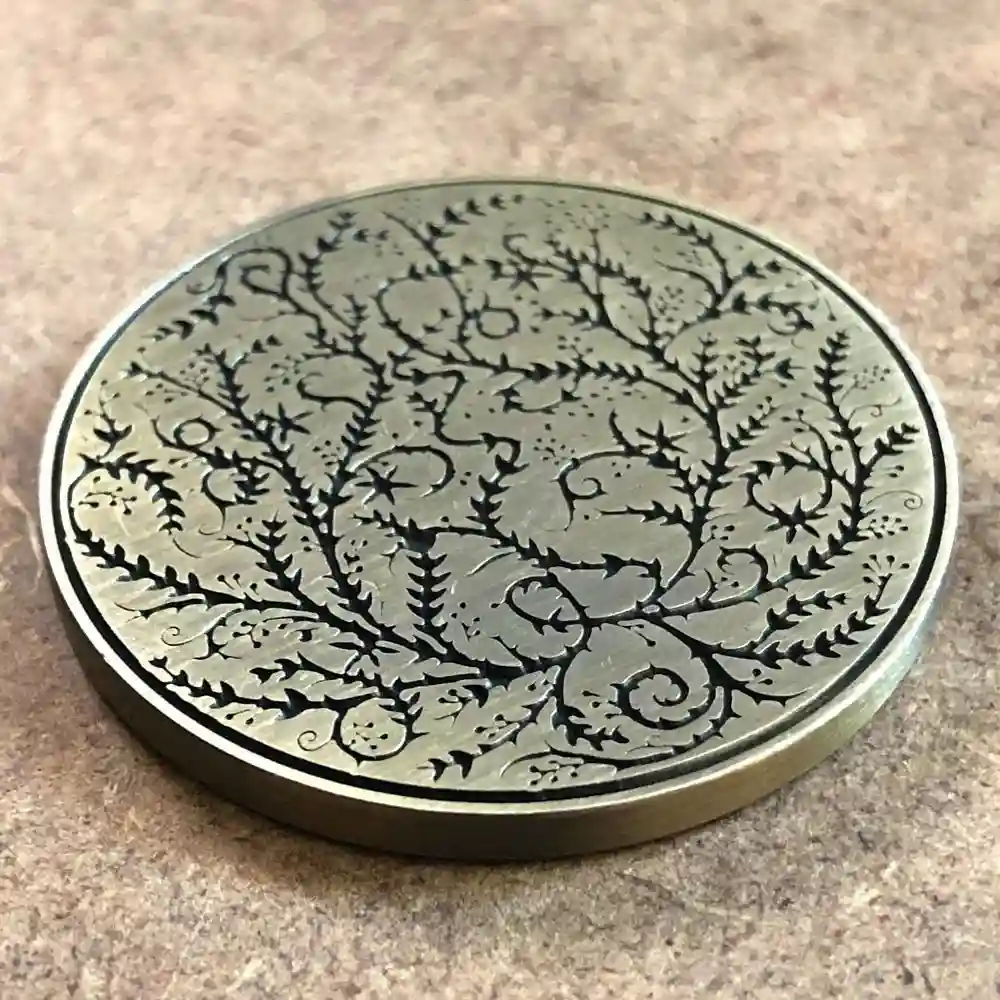
Despite the name, a 2D challenge coin is not flat like a piece of paper. It actually has real physical texture — you can feel it with your fingertips. What “2D” refers to is the number of relief levels in the design.
A 2D coin has exactly two metal levels: a raised foreground and a recessed background, separated by clean, vertical cuts. Think of it like a stamp pressed into metal — every element sits at one of two clearly defined heights, with crisp, sharp edges between them.
This manufacturing process is called die-striking, and it’s the industry standard for most custom challenge coins. It’s precise, efficient, and highly scalable — which makes it the go-to choice for larger orders.
A 2D coin works beautifully for:
- Brand logos and wordmarks
- Company emblems and seals
- Geometric or graphic-style designs
- Text-heavy layouts
- School or organizational insignias
Typical thickness runs from 2.5 mm to 3 mm, making 2D coins solid and satisfying to hold without being unnecessarily bulky. If your design looks great on a screen or on paper, chances are it will look excellent as a 2D challenge coin.
What Is a 3D Challenge Coin?
Here’s where things get more exciting — and more intricate.
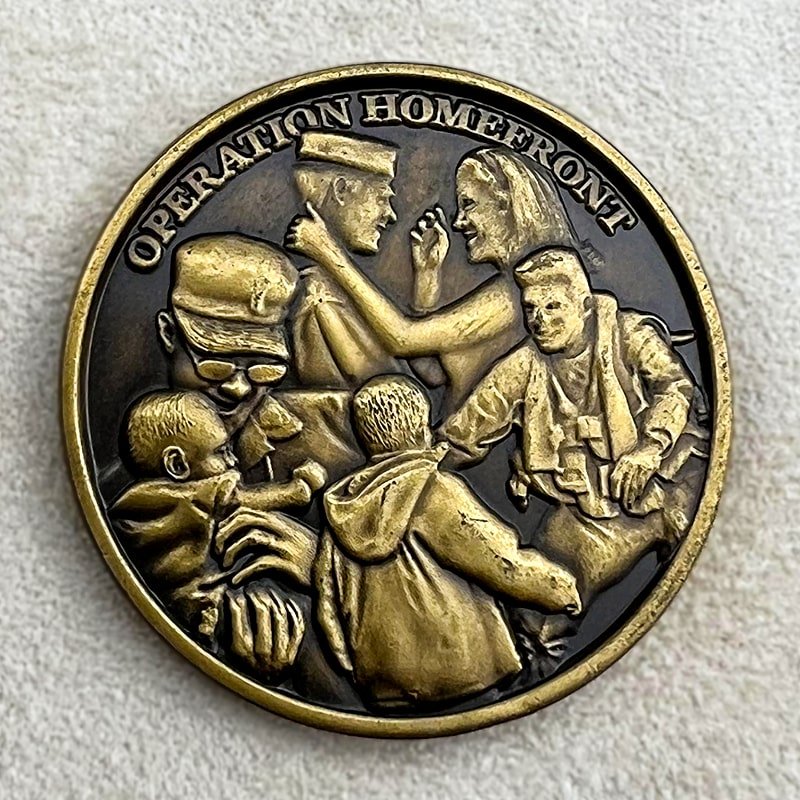
3D challenge coins go beyond two levels. Instead of sharp, vertical cuts between design elements, a 3D coin uses gradual slopes, rounded edges, and sculpted relief to create depth. The result looks and feels like a miniature sculpture — because, in a way, it is one.
To produce a 3D coin, manufacturers create a separate specialized mold that carves the design in multiple planes. The raised elements don’t just sit “up” — they curve, contour, and flow into each other, giving the coin a dimensional, lifelike quality.
This is also why 3D challenge coins typically carry a higher price tag. The sculpting work is more labor-intensive, the mold more complex, and the production time longer. But when it’s done right, the result is genuinely stunning.
3D challenge coins shine when your design includes:
- Portraits or human faces
- Animals with fur, feathers, or scale texture
- Architectural landmarks or buildings
- Military insignia with complex layered details
- Mechanical or cyberpunk-style artwork
Coin thickness for 3D designs typically ranges from 3 mm to 10 mm, depending on how much relief the sculpture requires.
2D vs 3D Challenge Coins: The Key Differences at a Glance
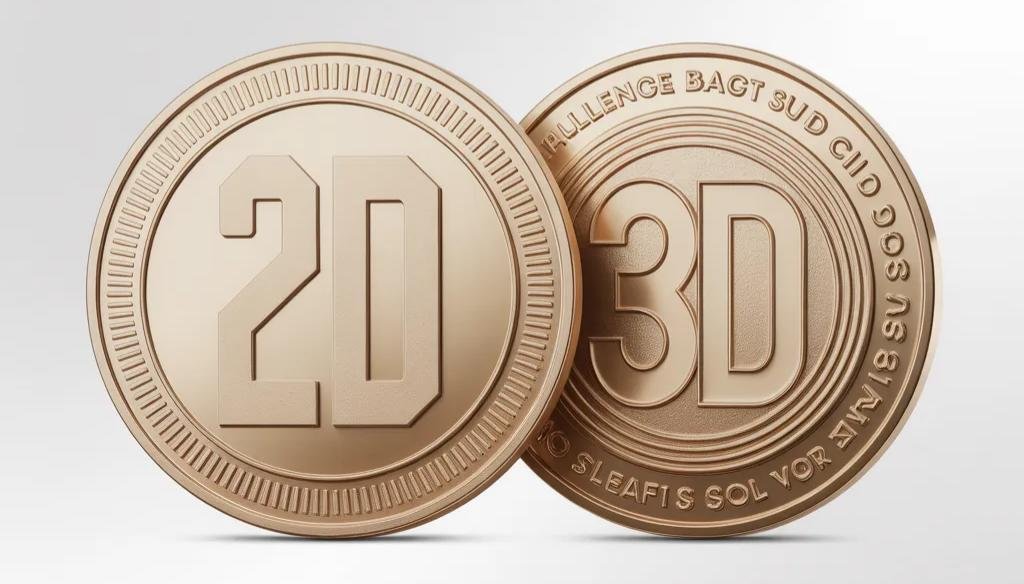
Here’s a quick side-by-side comparison for buyers who need to make a sourcing decision fast:
| Category | 2D Challenge Coin | 3D Challenge Coin |
|---|---|---|
| Relief levels | 2 fixed levels (stepped) | Multiple gradual levels (sculpted) |
| Edge style | Vertical cuts, sharp boundaries | Sloped transitions, smooth curves |
| Typical thickness | 2.5 mm – 3 mm | 3 mm – 10 mm |
| Color fill | Easy — enamel fills cleanly | Difficult — special technique required |
| Best design types | Logos, text, flat graphics | Portraits, animals, architecture |
| Relative cost | Lower | Higher (20–40% premium typical) |
| Production time | Faster | Longer (extra mold work) |
The short version: 2D = color + clarity. 3D = depth + realism.
The Color Question: More Important Than You Think
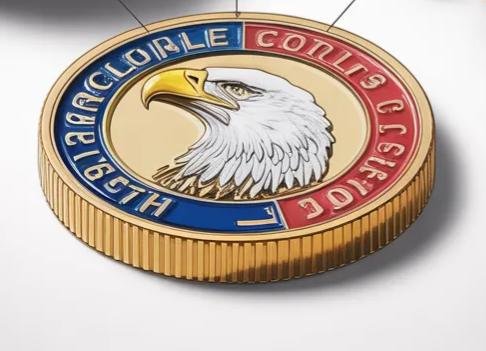
This is the detail that catches most buyers off guard, so let’s give it the attention it deserves.
2D coins are excellent at holding color. Because the transition between design levels is a sharp vertical wall, those walls act as natural barriers that contain liquid enamel during the fill process. The result is vibrant, Pantone-accurate colors with clean, well-defined edges — perfect for brand identity work where color consistency matters.
3D coins, however, cannot typically be color-filled on the sculpted areas. The sloped, curved surfaces have no containment walls to hold liquid enamel in place, so it bleeds and pools unpredictably. Most 3D challenge coins are finished in their natural metal — polished gold, antique silver, brushed bronze — and rely on the play of light across the sculpted surface for their visual impact.
There is, however, a clever workaround: the hybrid approach. A skilled manufacturer can create a coin where the central 3D sculpted element (say, an eagle or a portrait) sits within a 2D-style border that can be color-filled. You get the sculptural drama of a 3D centerpiece with the brand color accuracy of a 2D surround. It’s the best of both worlds — and a great option for mid-range budgets that still want a premium feel.
Cost and MOQ: What Bulk Buyers Need to Know
For traders, e-commerce platforms, and retail buyers, the economics matter just as much as the aesthetics. Here’s how the two options stack up when you’re ordering at volume.
2D challenge coins are the more budget-friendly choice. The die-striking process is efficient and well-established, mold costs are lower, and production runs move quickly. For large-volume orders — think 500 pieces and above — the per-unit cost drops significantly, making 2D an attractive option for retail packaging inserts, event giveaways, or loyalty program coins.
3D challenge coins require an additional sculpting mold, which adds both cost and lead time upfront. As a rule of thumb, budget roughly 20–40% more for a 3D design compared to an equivalent 2D order at the same quantity. For brands positioning their coins as premium collectibles or prestige awards, that premium is easy to justify. For high-volume, price-sensitive orders, it often isn’t.
One more thing to keep in mind on size: 3D detail gets lost on small coins. If your coin is smaller than 1.75 inches in diameter, the sculpted relief simply doesn’t have enough real estate to show its best work. For small-format coins, 2D almost always delivers better detail and clarity.
Which Should You Choose? A Quick Decision Guide
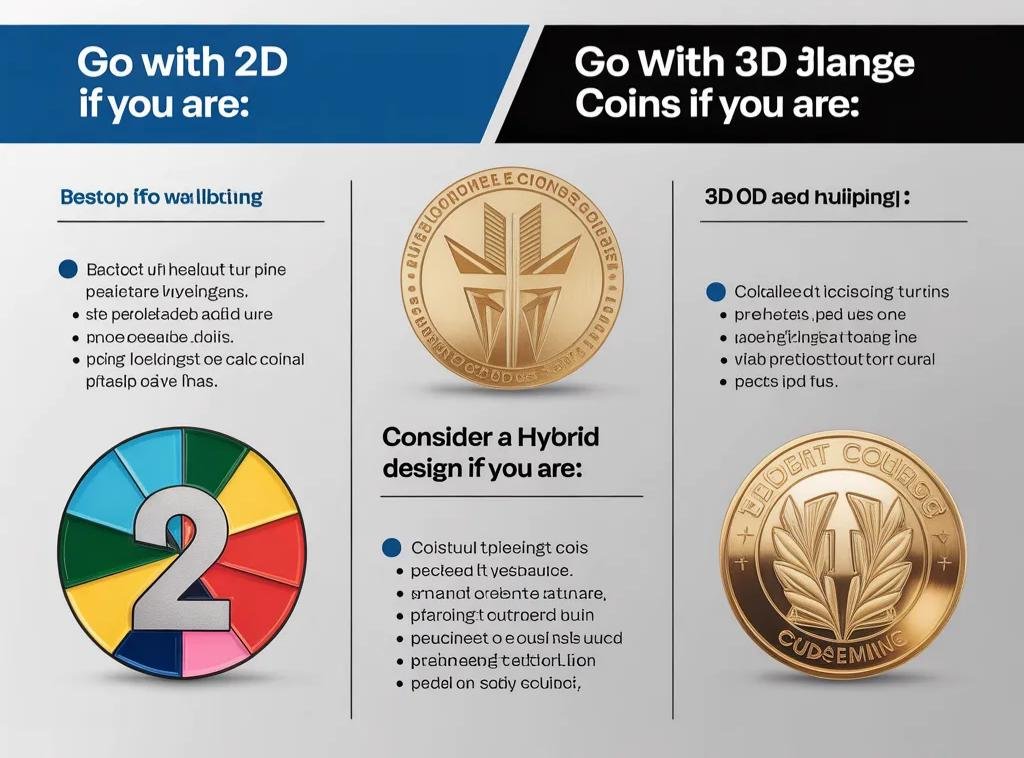
Still on the fence? Here’s a practical guide based on the most common buyer scenarios we see:
Go with 2D if you are:
- An e-commerce brand creating logo-branded merchandise or packaging inserts
- A corporate buyer ordering coins as gifts or recognition awards where brand colors must match exactly
- A retailer sourcing a high-volume run at competitive cost
- Working with a design that is primarily flat — text, icons, geometric shapes, flag-based imagery
Go with 3D challenge coins if you are:
- A premium brand building a collectible series with display value
- Sourcing military, first-responder, or veteran appreciation coins where realism and detail carry emotional weight
- A retailer or trader targeting the collector market, where sculptural quality commands a higher retail price
- Working with a design that features portraits, animals, or architectural subjects that genuinely benefit from dimensional depth
Consider a hybrid design if you are:
- A brand that wants visual impact and color accuracy in the same coin
- Working with a moderate budget and a design that has both a focal illustration and surrounding brand elements
How to Submit Your Artwork
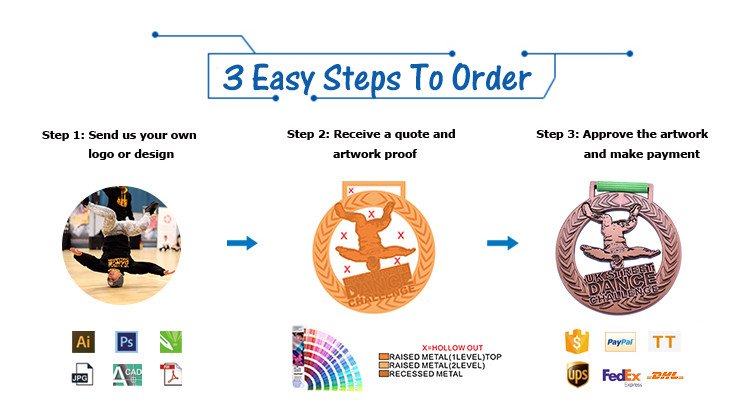
Once you’ve decided between 2D and 3D, getting your design to us is straightforward.
For 2D coins: Vector files work best — AI, EPS, or high-resolution PDF. Clean, high-contrast artwork with well-defined edges will translate beautifully into a die-struck design. If your logo already looks sharp on a business card or website, it’s ready.
For 3D challenge coins: You don’t need to supply a 3D model (though if you have one, we’ll take it). Reference images from multiple angles, sketches showing depth and layering, or even photos of a physical object you want us to replicate all give our sculptors what they need to build your mold accurately.
Not sure your artwork is ready? Our team offers a free design proof with every order — we’ll show you exactly how your coin will look before a single piece of metal is struck.
Ready to Order? Let’s Build Your Coin.
Choosing between 2D and 3D comes down to two questions: What does your design look like? And what impression do you want to leave? For sharp, colorful brand identity — go 2D. For sculptural, collectible impact — go 3D. And when you want both, we know exactly how to blend them.
At Unique Custom Pins, we produce 2D, 3D and die-struck challenge coins with factory-direct pricing, free artwork, and bulk pricing available for traders, brands, and retail buyers of all sizes.
FAQs
Can I have both 2D and 3D elements on the same coin?
Yes — this is the hybrid approach described above. A sculpted 3D centerpiece surrounded by a 2D color-filled border is one of our most popular configurations.
Is 3D always more expensive than 2D?
Generally yes, due to the additional mold and sculpting work. The premium is typically in the 20–40% range, though it varies by design complexity and order size.
Which type is better for small coins (under 1.5 inches)?
2D. The finer details in a 3D design are difficult to appreciate — and even harder to produce accurately — on very small coin faces. 2D keeps lines crisp and text legible at smaller sizes.
Can 3D coins have any color at all?
The sculpted 3D elements themselves cannot be enamel-filled. However, non-sculpted areas of the coin (borders, backgrounds, text panels) can still carry color. A hybrid design approach makes this possible.
How much longer does 3D production take vs 2D?
Expect to add approximately 5–10 business days for the additional mold creation and sculpting review stages in a 3D order.