








Quick Answer
For gift shop buyers developing custom souvenir keychains, start with one or two features that identify the landmark, such as a distinctive roofline or arch arrangement. Let these guide the outline, then leave room for a readable place name.
Reducing a full scene to keychain size can make small details merge and leave too little clear space for the place name. Remove background details that do not help identify the location. Check whether fine lines and small openings can be reproduced at the intended size with the chosen production method.
Which Detail Makes Your Destination Recognizable?
Sky may fill half a reference photograph, while visitors recognize the place from its roofline, building proportions, or coastal outline. Give those identifying features priority in the keychain artwork.
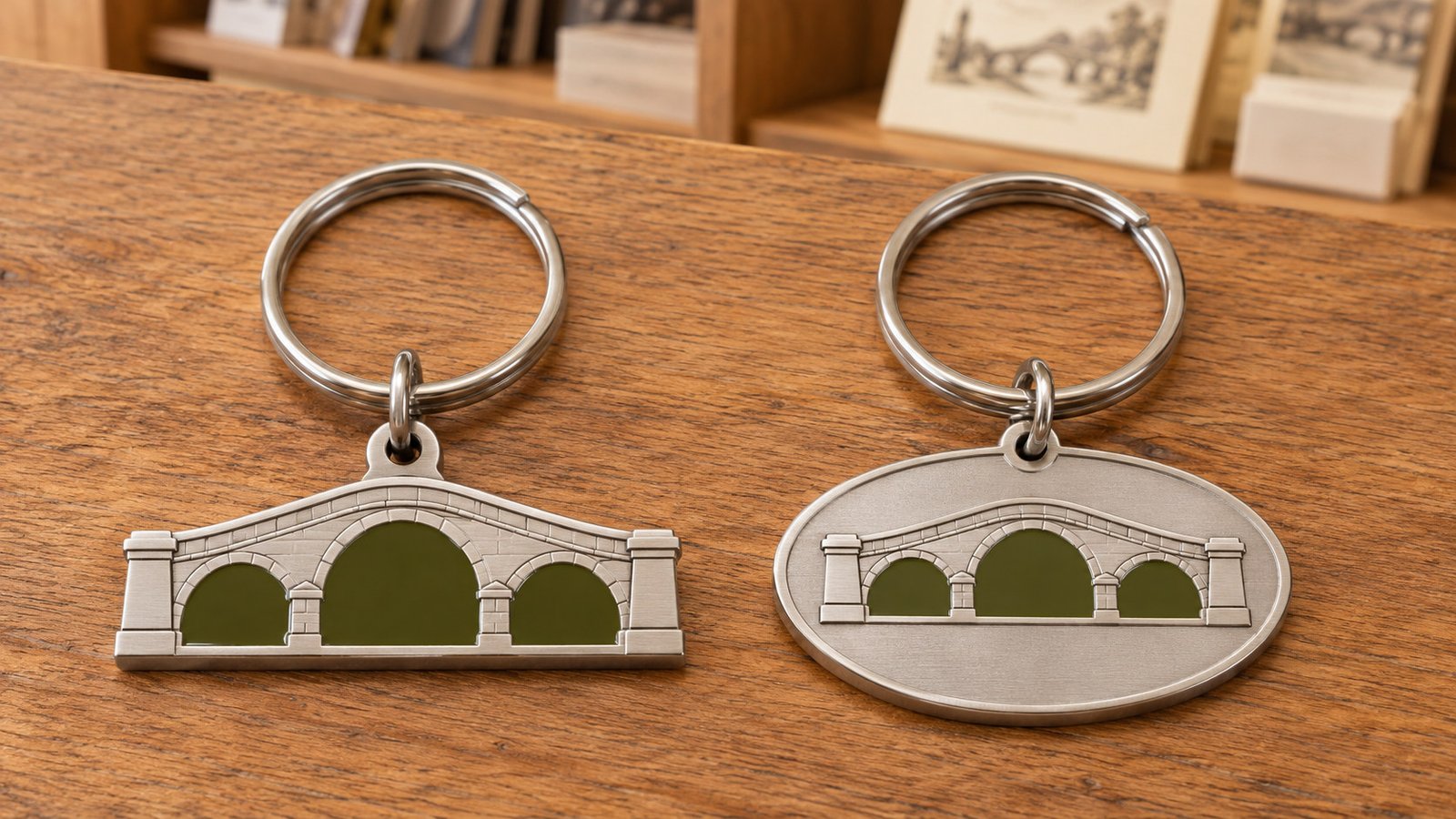
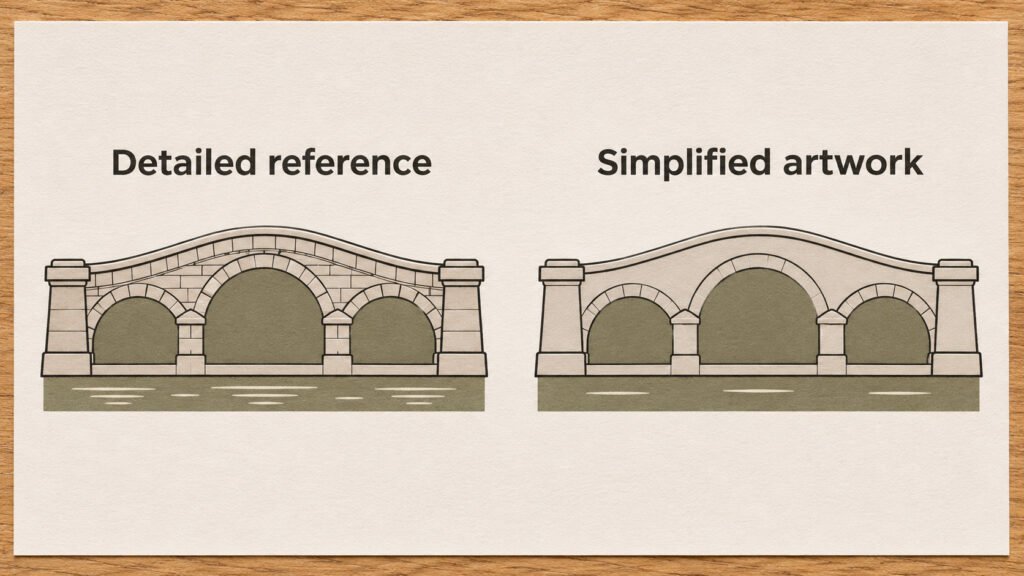
Consider a fictional three-arch stone bridge, used here as an illustrative design example. Its central arch is taller than the two side arches. The arch count and relative heights would be details to preserve; replacing them with three equal arches would change the reference. Those features alone, however, would not necessarily identify a particular place.
If the landmark has a common outline, its name or location can supply the missing context. Mark essential features directly on the reference and explain what must remain unchanged. This gives the designer clearer direction than a general request to reproduce the photograph faithfully.
Should the Landmark Define the Outline or Sit Inside a Frame?
For custom metal keychains, use the landmark’s outer profile when its silhouette is a feature visitors recognize. A round or oval frame can help when recognition depends on internal details or when the place name needs a dedicated area.
| Approach | Best fit | Design tradeoff |
|---|---|---|
| Landmark-shaped outline | A distinctive outer profile | Narrow projections and the attachment eye may require changes to the outline. |
| Landmark inside a frame | Internal features, surroundings, or a place name need space | At a fixed body size, a wider border leaves less room for the landmark and lettering. |
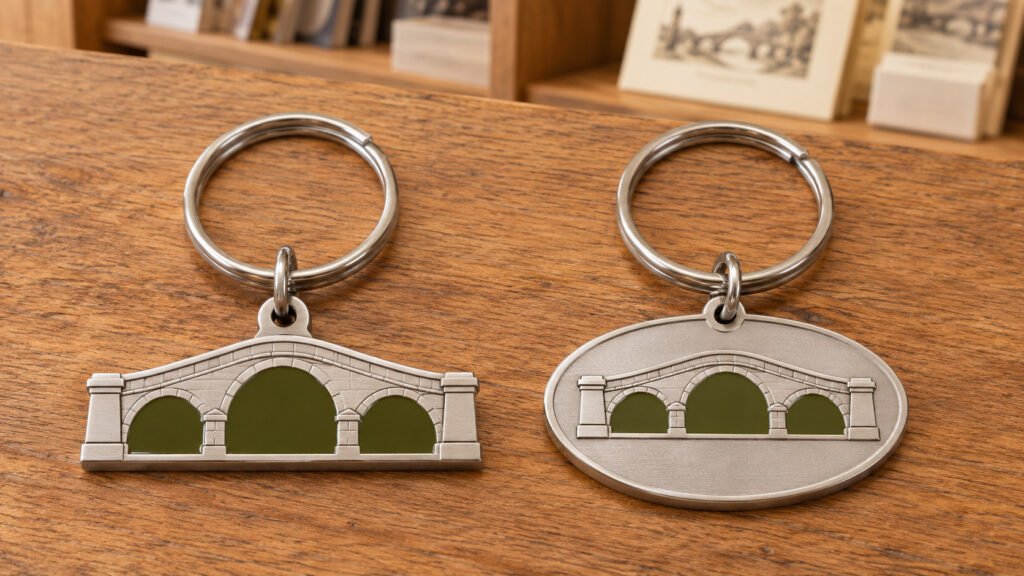
For the fictional three-arch bridge, a bridge-shaped edge does not automatically communicate the number of arches. Those arches must remain distinguishable within the design. A through-opening passes all the way through the body. Raised, recessed, or printed arches can instead appear on a solid surface.
Compare the shaped and framed layouts within the same maximum body dimensions, excluding the ring. Choose the layout that gives the landmark and its name enough room without changing the identifying features.
Which Details Can You Simplify Without Losing the Landmark?
Repeated stone joints and small reflections on the water may add realism to a photograph without helping visitors recognize the bridge. Simplify these details first if they compete with the main structure. Use fewer masonry lines while keeping the arches separate and their height differences visible.
Surrounding trees and buildings need separate consideration. An ordinary tree at the edge of the photograph may be dispensable, while a distinctive tower beside the bridge could help identify the location.
Keeping every background element can force the bridge into a smaller area. Removing the whole setting can lose useful context. Retain surroundings that explain which place is shown, and reduce those that merely fill the photograph.
Where Should the Place Name Sit?
Give the name visitors are most likely to recognize the clearest text position. For a city gift shop, that may be the city name, with the landmark providing the visual connection. When visitors come specifically for a particular museum or attraction, prioritize that site’s own name.
Place the name in a clear area above or below the image, where letters do not merge with rooflines or arches. For a long name, try a second line or move secondary information before reducing the type size. Keep the official wording unless an approved shorter form exists.
Include an institution’s logo, a year, or a slogan only when it helps identify the organization or mark a specific occasion. Useful secondary information can move to the reverse if the front becomes crowded. If the front carries everything needed, the back can remain undecorated.
Will Shoppers Recognize It at Its Finished Size?
An enlarged screen view can hide crowding. Print the artwork at the proposed finished dimensions and verify the print size with a ruler. Include the planned frame, attachment eye, and ring position.
- Can you still distinguish the defining proportions and openings?
- Can you read the place name without magnification?
- Does the proposed frame or attachment position cover a defining feature in the layout?
This paper check helps assess layout and readability; it cannot confirm metal appearance, hardware movement, strength, or durability. If the arches merge visually, give the bridge more room. If the name is hard to read, simplify the area behind it or move the lettering.
Häufig gestellte Fragen
Can we start with a landmark photograph instead of vector artwork?
Yes. A clear photograph can serve as a design reference. Mark the features that must remain unchanged, and add another angle if important details are hidden. The image still needs to be adapted into suitable production artwork; see our guide to preparing keychain artwork.
Can this approach work for a park or coastline rather than a building?
Yes. Look for features specific to that location, such as a headland’s profile, a distinctive rock formation, or a recognizable lake outline. Generic waves or trees may not identify the destination on their own. Use the accurate place name when the image needs additional context.
Planning merchandise for a museum, attraction, or destination shop? Share your landmark reference, exact place name, and the features that must stay. Include a target size if known. We can discuss whether a shaped outline or framed layout gives the landmark and lettering enough room.