







Challenge coins have come a long way from their military roots. Today, brands, e-commerce stores, corporate teams, and retail buyers are all discovering what soldiers have known for decades: a well-made custom coin is more than a token — it’s a tangible symbol of identity, achievement, and belonging.
If you’re exploring custom shape challenge coins for the first time — or you’ve been burned by surprise costs and production delays before — this guide is for you. We’ll walk through what shapes are actually possible, what design limitations you need to know before submitting artwork, and how challenge coin pricing really works so you can build an accurate budget from day one.
What Are Custom Shape Challenge Coins — and Why Does Shape Matter?
Most people picture a round, thick metal disc when they think of a challenge coin. And while round coins remain the most popular format, custom shapes are where things get really exciting for brands and resellers.
A custom shape challenge coin is any coin that breaks from the standard round outline — think state silhouettes, company logo outlines, shield shapes, animals, or even product-shaped coins for e-commerce brands. The shape is cut using a custom die mold, which means the outline is precision-stamped into metal during production.
Why does shape matter so much? Because it’s the first thing someone notices. A round coin says “standard.” A coin shaped like your brand’s icon says “we put thought into this.” For traders and retail buyers sourcing coins at scale, custom shapes also command higher perceived value — which means better margins.
Types of Custom Shapes Available
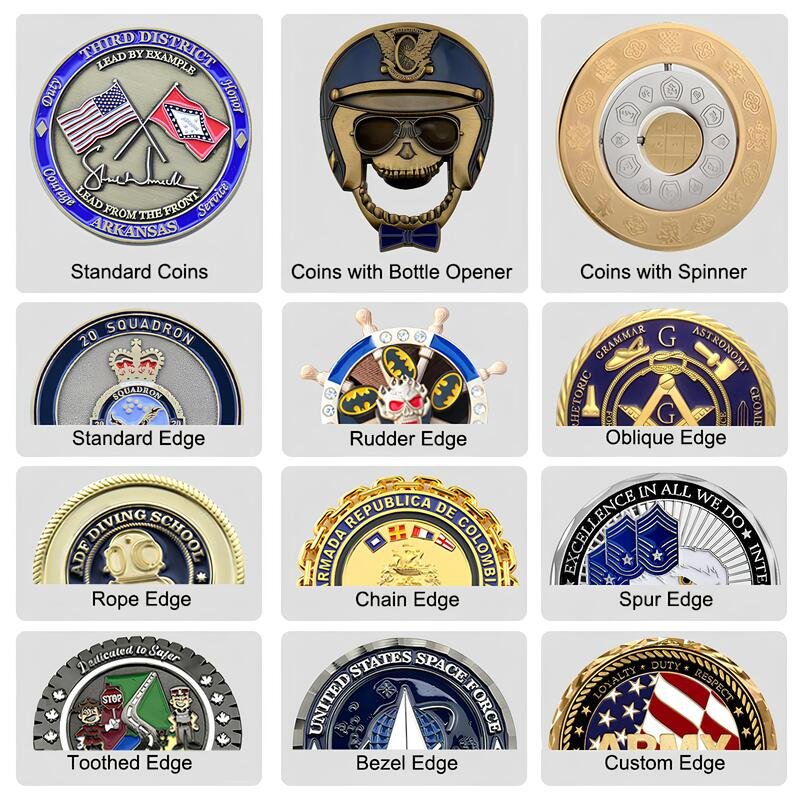
Before you start dreaming up your design, it helps to know what the manufacturing process actually supports. Here’s a quick breakdown of shape types, from simplest to most complex:
- Standard shapes (round, oval, square, rectangle) — lowest tooling cost, fastest turnaround
- Die-cut custom outlines — logo shapes, state outlines, animal silhouettes, product-specific forms
- Internal cutouts — negative space within the coin (e.g., a star-shaped hole inside a shield coin)
- 3D sculpted coins — raised, dimensional relief on one or both faces
- Specialty formats — spinner coins, bottle opener coins, multi-layer puzzle coins, oversized 3″+ coins
Buyer tip: Custom die-cut shapes require a unique mold to be produced. Always factor the mold fee into your unit cost comparison — more on this in the pricing section below.
Design Limitations: What You Must Know Before Submitting Artwork
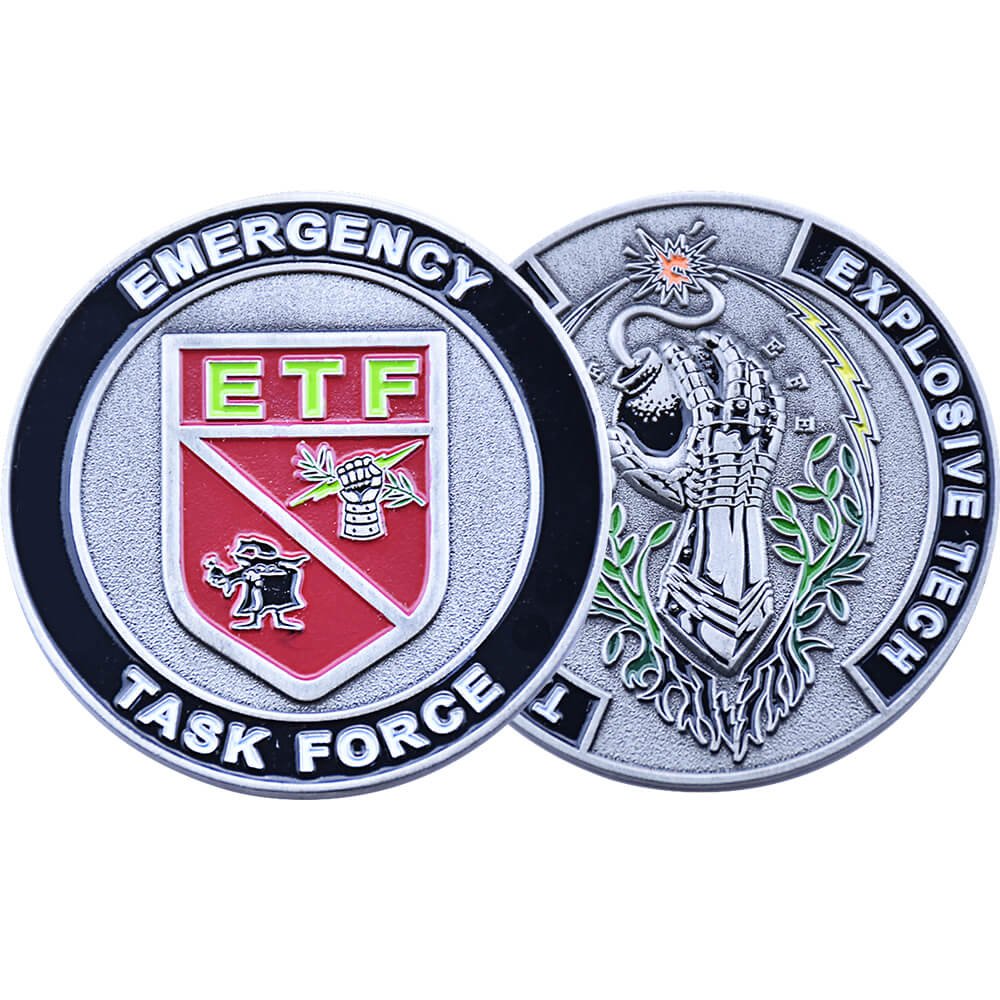
This is the section most suppliers skip — and it’s the reason so many first-time orders hit unexpected delays. Metal is not paper. What looks clean on a screen may not translate cleanly when struck into zinc alloy or brass. Here’s what every buyer, designer, and brand manager needs to understand upfront.
1. Metal Tooling Has Minimum Line Widths
Lines thinner than approximately 0.3mm will not strike cleanly in metal. They either disappear or merge with adjacent areas. The same applies to fine serif fonts — a typeface that looks elegant on a business card will become an unreadable blur on a coin. Stick to bold, clean fonts and simplify any intricate linework before submitting.
2. Gradients and Photography Don’t Translate
Enamel-filled coins rely on raised and recessed areas to define color zones. Photo-realistic artwork, gradients, and drop shadows simply don’t exist in this process. If your design includes these elements, they’ll need to be redrawn as simplified, flat zones before production can begin — which takes time and may incur redrawing fees.
3. Custom Shape Complexity Has Structural Limits
Extremely concave curves, needle-thin protrusions, and coins with very large open cutout areas can be fragile or structurally unstable. Thin connectors between design elements (called “bridges”) need to meet a minimum width to hold the coin together. A good manufacturer will flag these issues during the proof stage — but the earlier you know, the better.
4. Color Zones and Enamel Types
There are two main enamel types: soft enamel (recessed, textured feel, more affordable) and hard enamel (flush, smooth, premium look). Both have a practical limit of around 6–8 distinct colors per side before costs spike and registration accuracy drops. If your brand palette has more colors than that, prioritize your primary brand colors and let the metal finish do the rest of the visual work.
5. Challenge Coin Size Affects Everything
Challenge coin size is one of the most important spec decisions you’ll make. Standard sizes run from 1.5″ up to 3.0″ in diameter, with 1.75″ and 2.0″ being the most popular sweet spots. Larger coins feel more premium and allow for more design detail, but they cost more per unit and add weight to packaging. Smaller coins are budget-friendly but less forgiving of complex designs.
Standard thickness runs around 3mm, with premium orders sometimes going up to 5mm for a truly substantial feel in the hand. For retail buyers and e-commerce SKUs, the 2.0″ size at 3mm thickness consistently tests well as the “just right” format.
Challenge Coin Pricing: How Much Does It Cost to Make a Challenge Coin?
“How much does it cost to make a challenge coin?” is the most common question we hear — and the honest answer is: it depends on five key variables. Here’s how each one affects your final per-unit cost.
| Pricing Variable | Impact |
| Size (1.5″ → 3.0″) | +20–60% as diameter increases |
| Quantity (50 → 500+) | Significant per-unit drop at 100, 300, 500 thresholds |
| Shape complexity | Custom die-cut adds mold fee (~$50–$200, often waived at 300+ units) |
| Colors & enamel type | Each additional color side adds cost; hard enamel costs more than soft |
| Plating & edge treatment | Antique/dual plating and specialty edges add per-unit cost |
Ballpark Price Ranges
To give you a realistic starting point for budgeting:
- 50–99 units, standard round, no color: approximately $5–$8 per coin
- 100–299 units, custom shape, soft enamel 2 colors: approximately $4–$6 per coin
- 300–499 units, custom shape, full color: approximately $3–$5 per coin
- 500+ units, bulk production: approximately $2.60–$4 per coin
Important: Many manufacturers waive mold fees for orders of 300+ pieces on standard-sized coins. Always ask — it can save you $100–$200 per new shape.
Hidden Cost Triggers to Watch For
Challenge coin pricing surprises usually come from a handful of recurring culprits:
- Artwork redrawing fees — if you submit a JPG or PNG instead of vector art (AI, EPS, SVG)
- Rush production surcharges — standard lead time is 10–15 business days; rush can add 20–40%
- Packaging upgrades — velvet pouches, acrylic display boxes, and PVC envelopes all add per-unit cost
- Sequential numbering or edge engraving — popular for limited-edition runs
- Dual plating or specialty finishes — glow-in-the-dark and glitter paint effects
How are Challenge Coin Made? The Step-by-Step Process
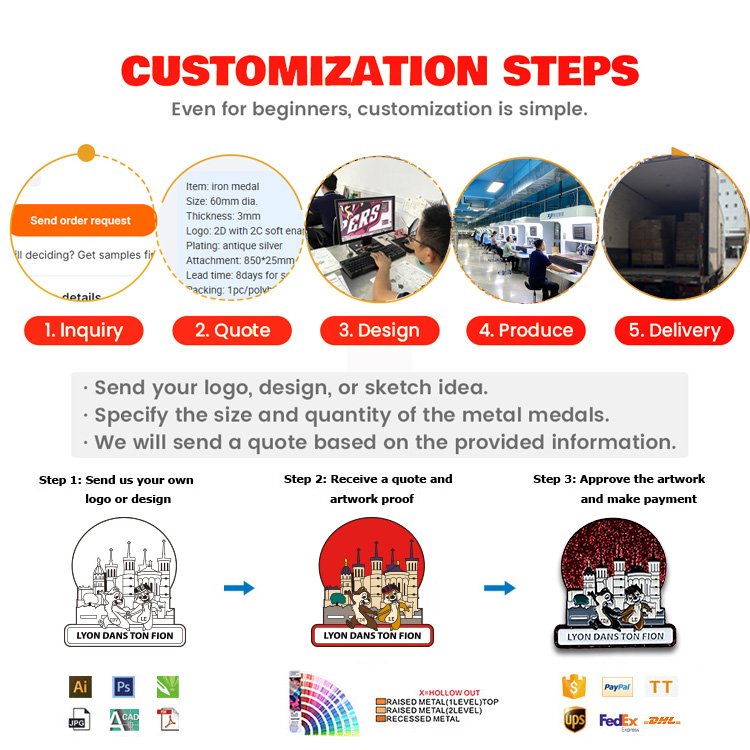
First-timers often ask: “How do you get a challenge coin?” The good news is that the process is more straightforward than most people expect when you work with an experienced manufacturer. Here’s the typical flow:
Step 1 — Define your specs: Set your purpose, quantity range, size, and finish before approaching any supplier.
Step 2 — Prepare your artwork: Vector files (AI, EPS, SVG) are preferred. If you only have a raster logo, expect to budget for redrawing.
Step 3 — Request a quote: Submit all specs at once — size, shape, quantity, colors, plating, and packaging. Incomplete briefs lead to inaccurate quotes.
Step 4 — Review your digital proof: Check every detail — spelling, dates, color codes, layout. This is your last free chance to fix mistakes.
Step 5 — Approve and produce: Once you approve, production begins. For orders of 500+, request a pre-production physical sample before the full run.
Step 6 — Receive and verify: Inspect your shipment against the approved proof. Reputable manufacturers stand behind their quality.
The Importance of Custom Challenge Coin Sample Coin Reviews
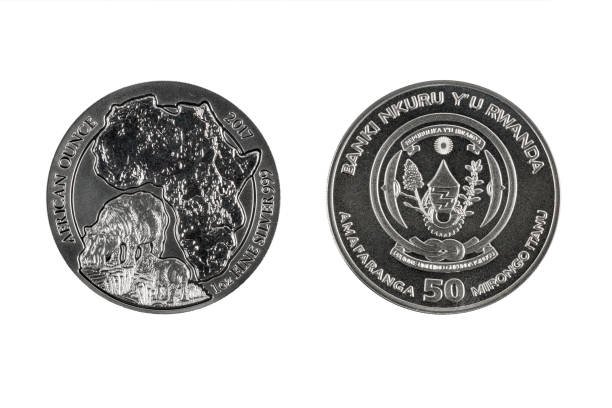
For bulk buyers, traders, and e-commerce sellers, custom challenge coin sample coin reviews are a non-negotiable part of the sourcing process. A digital proof tells you how a coin will look. A physical sample tells you how it will feel — weight, edge finish, enamel texture, plating color accuracy — all the tactile qualities that determine whether a coin feels like a premium product or a cheap promotional trinket.
Pre-production samples typically cost $30–$80 and are often credited back against your full order. If a supplier refuses to offer samples or can’t turn around a sample within 7–10 business days, treat that as a red flag.
Pro tip for e-commerce sellers: Order a sample of each SKU before listing. Customer reviews consistently mention coin weight and finish quality — getting this right upfront protects your ratings.
Sourcing Tips for Traders, Brands & Retail Buyers
If you’re sourcing at scale, a few extra steps can protect your margins and your reputation:
- Negotiate mold ownership — owning your mold means reorders don’t cost extra tooling fees
- Confirm white-label packaging — no manufacturer branding on coin or box for resale products
- Test before scaling — 50–100 piece test runs validate market demand before committing to 1,000+
- Align specs before getting quotes — identical specs make supplier comparisons meaningful
- Ask about NET payment terms for repeat orders if you’re placing volume business
Ready to Order Your Custom Shape Challenge Coins?
Getting your specs right before you place an order is the single most effective way to keep your challenge coin pricing on budget and your timeline on track. Whether you’re ordering 100 coins for a brand campaign or 5,000 units for retail distribution, the variables are the same — size, shape, quantity, finish, and packaging.
At Unique Custom Pins, we work with traders, brands, e-commerce platforms, and retail buyers every day to turn design ideas into production-ready coins. Free design service, unlimited revisions, and transparent pricing — no hidden fees, no surprises. Get a free quote today — tell us your shape, quantity, and finish, and we’ll have a detailed quote back to you within 24 hours.
FAQs
Can I make a coin in literally any shape?
Almost. The main constraints are structural — extremely thin protrusions or very large internal cutouts may require design adjustments. A good manufacturer will advise you during the proof stage.
What’s the minimum order quantity?
Most manufacturers offer a minimum of 50 pieces. However, unit costs drop meaningfully at 100, 300, and 500+ thresholds, so it’s worth considering your full anticipated demand before placing a small test order.
How do I know if my colors will be accurate?
Specify Pantone (PMS) color codes in your brief. Most quality manufacturers match to PMS standards. Always verify against your proof before approving production.
What’s the difference between soft and hard enamel?
Soft enamel sits in recessed areas and has a textured, layered feel. Hard enamel is polished flush with the metal surface for a smooth, premium finish. Hard enamel costs more but photographs beautifully — a consideration for e-commerce product listings.